In this article we’ve excluded Scouting-related stamps as these are numerous.
The Netherlands 2025
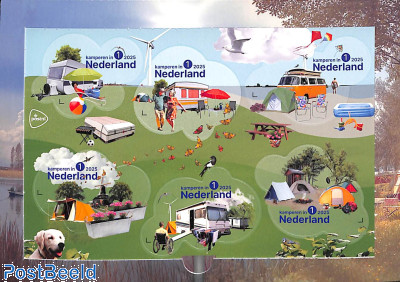
The “Camping in the Netherlands” stamp sheet seen here contains six stamps in different designs, each featuring a different camping vehicle: from caravans and camper vans to small tents. The stamps feature a cloud-shaped cutout and, together with the background illustration, form a continuous camping scene. The sheet border depicts a typical Dutch landscape with grassy fields, sandy beaches, and swimming waters under a clear summer sky. The sheet includes a perforated postcard with summer greetings and an information board full of humorous camping tips. The back of the sheet features a simple camping recipe for macaroni, complete with an illustration. Numerous recognizable camping details are depicted across the stamps and the sheet border: from barbecues and trailer tents to dogs, butterflies and footballs.
Luxembourg 2010
In 2010 Luxembourg issued the above stamps with the subject being fun and freedom.
Denmark 2011
This pair of stamps from Denmark entitled “Camping Life” from 2011 have a kind of retro look and strangely the Krone 8 stamp features a gnome.
Portugal 1975
Camping and caravanning set produced by Portugal in 1975 with, below a phosphor-striped version of the 2.00 Escudo stamp.
Portugal 1975South Korea 2002
The 2002 South Korean camping postage stamp’s significance was symbolic as it highlighted the growing popularity of camping as a leisure activity in the country at a time when it was also gaining international attention for co-hosting the 2002 FIFA World Cup.
Australia 2007
In 2007, Australia released the set of stamps “Caravanning Through the Years,” which feature images of caravanning from different decades. The stamps depict scenes for each decade from the 1950s to the 1980s, plus the stamp far right showing what was, in 2007, “Caravanning Today”.
Finland 1968
And then we go back to 1968, when Finland issued a stamp to promote summer vacations, featuring a scene with a camping area. It was part of a series to publicise Finland for tourism during that year.
PostBeeld’s Dutch and Belgian stamp blog has some great contributors. Generally they go into far more detail with their articles than the English language blog, with its shorter stories. One of our Dutch authors is Cees Janssen whose superb articles have graced the pages of the Dutch website for many years. This is Part Two of a typically lengthy and informative article written by Cees in 2022. It features the history of the printing company De la Rue and its founder Thomas de la Rue (1793 – 1866).
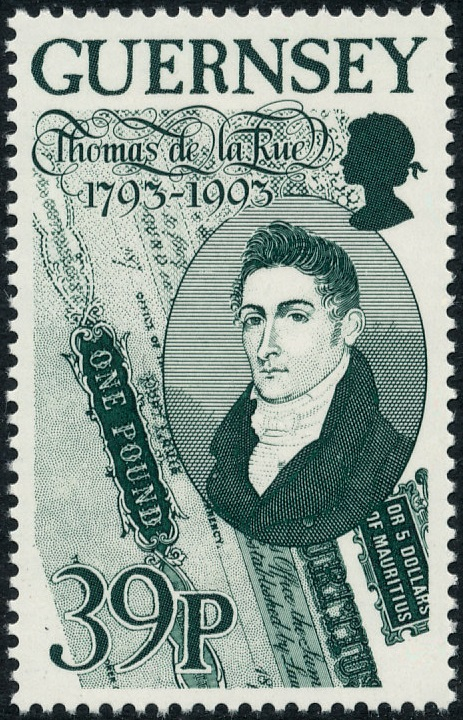
De La Rue printed the first banknote in 1860. These were Mauritian banknotes in denominations of 10 shillings, £1, and £5. The stamp shows a fragment of the first Mauritian banknote of one Pound or five Mauritian Dollars.
The only postage stamp printed for the United States by order of the Confederate States was a 5-cent stamp in blue. The blue on the original stamp was much lighter than that on the reproduced stamp above.
This stamp was issued on April 16, 1862, and featured a portrait of President Jefferson Finis Davis. During the American Civil War, Davis served as the first and only president of the Confederate States of America, serving from 1861 to 1865. Thomas de la Rue used a portrait taken by photographer Mathew Benjamin Brady. A second stamp, denominated in dark orange and depicting politician John Caldwell Calhoun, was printed but not issued.
For European countries, Thomas de la Rue printed stamps like the example above, an Italian stamp issued on December 1, 1863, depicting King Victor Emmanuel II. The printer also printed a security feature on the obverse of the Italian stamp for the first time.
The first practical fountain pen was developed by De La Rue in 1881. This led to the luxury Onoto pen, launched in 1905. One of the most famous users of the Onoto pen was Winston Churchill. Production of these pens ceased in 1958. In 2005, a new manufacturer, the Onoto Pen Company Ltd., in Colney Hall, Norwich, resumed production of this brand.
The production of stamps for Great Britain boomed. Now highly sought-after stamps with high denominations came from the De La Rue printing presses in the printing works built in 1874 on Bunhill Row, a street in London’s Islington district, now the B144. The £1 stamp pictured above was issued on July 16, 1902, bearing a portrait of King Edward VII.
Another beautiful example of De La Rue’s printing art is a stamp from a set of four issued in 1913. The intaglio stamp of a half crown pictured above was issued in December 1915. In 1921, the De La Rue family left the company, which then became state-owned. On September 11, 1940, the factory and printing works at 110 Bunhill Row were destroyed by German bombers during the Blitz. The production of stamps, securities, and other products was moved to a factory outside London.
De La Rue became one of the most important banknote producers. Governments from around the world ordered huge quantities of this type of security. A test banknote, also used for presentation purposes, is depicted with a portrait of Thomas de la Rue. In the background is the facade of the printing works on Bunhill Row.
But his portrait as a young man also appeared on a genuine banknote issued in 2013 by Guernsey in the £1 denomination. The first money counting machine was developed by De La Rue and launched in 1957. Competitor Waterlow & Sons, a banknote and security printing company, was acquired by De La Rue in 1961.
The background of the banknote depicts Old Fountain Street in St. Peter Port as it appeared in a 1799 watercolour. Every detail in the painting has been meticulously reproduced on the banknote. At the end of the street is the Town Church. The church, built between 1466 and 1473, still stands, but the street from that time is completely unrecognizable and has been called Fountain Street since 1820. Since 1820, all the houses and shops have been demolished, the street has been re-laid, and new construction has been carried out. The watercolor was first reproduced in the 1842 Elizabeth College Magazine, published by George Métivier. The watercolor, pictured above, is also held in the collection of the Priaulx Library on Candie Road as a copy taken from the cover of a collection of poems in patois, the vernacular, published in 1883 by John Linwood Pitts.
The watercolour’s creator was wine merchant and lieutenant colonel in the artillery regiment Peter Le Lièvre, also known as Le Lievre, who lived from 1812 to February 17, 1878. He was born in a house just off Old Fountain Street, at 17 Hauteville in St. Peter Port, where he lived his entire life. A blue plaque, installed on his house in June 2010, commemorates this artist, who only became known after his death. The first exhibition of his work took place in 1904, 26 years after his death. The house where Victor Hugo lived during his exile, now a museum, is also located on this street.
The first self-adhesive stamps, the so-called “peel-off” system, for British stamps were developed by De La Rue. Pictured above is a test label with the silhouette of Thomas de la Rue.
This silhouette can still often be found on the sheet edges of stamps printed by De La Rue, such as the £2 stamp with a security feature against counterfeiting, issued on February 17, 2009. Thomas de la Rue, the versatile businessman and inventor, died at the age of 73 on June 7, 1866, in Kensington, London. He is buried in Kensal Green Cemetery in the Royal Borough of Kensington and Chelsea, London.
Maliavanka (painted carpet) is a special type of folk art in Belarus. Classified as a so-called naive art, a branch of primitivism, Maliavanka is a large (up to 2 meters) carpet, usually painted on homespun cloth painted in black.Maliavanka became widespread in the period from the 1920s to the 1960s. They were hung on the walls of houses for decoration or as a talisman. Gradually, this type of art began to decline due to the development of factory carpet production. Today, painted carpets can be seen in museums in Belarus. The largest collection (about 300 items) is in the collection of the Historical and Cultural Museum-Reserve “Zaslawje”. The most famous and original artists who worked in this direction are Aliena Kish and Jazep Drazdovich, whose works are presented on the postage stamps from the Maliavanka series.
The stamp above shows a carpet created by Alena Kish (1889-1949). Entitled “Maiden on the Waters”. Below, another of her beautiful creations, entitled “Paradise”.
The stamps below show carpets – “Catholic Church in Zadarozhzha” and “Landscape with Balustrade” – painted by Jazep Drazdovich (1888-1954).
Original carpets by Yazep Drozdovich and Elena Kish occupy an honourable place in the halls of the Museum of the Belarusian Maliavanka’s permanent exposition.
PostBeeld’s Dutch and Belgian stamp blog has some great contributors. Generally they go into far more detail with their articles than the English language blog, with its shorter stories. One of our Dutch authors is Cees Janssen whose superb articles have graced the pages of the Dutch website for many years. This is Part One of a typically lengthy and informative article written by Cees in 2022.
Many stamp collectors know the name “De La Rue” as a printing company that printed stamps for many countries. But who founded this printing company with a French name, and where is it located? The literal translation of “De la Rue” in English is “From the Street,” not an obvious name for a printing company. So where does it come from?
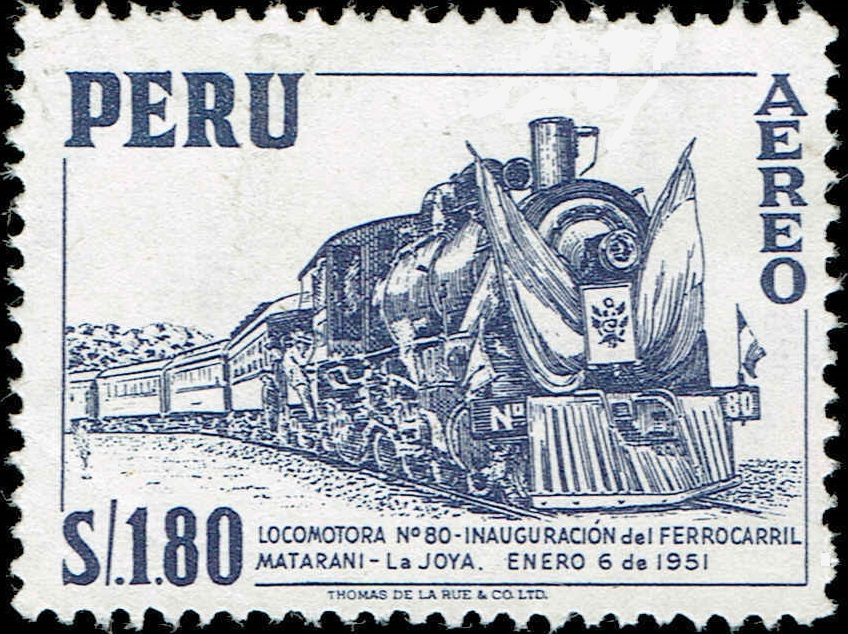
The stamp printing company often printed its name on the bottom edge of the stamps themselves. Take the example above, for example, of a Peruvian airmail stamp issued on November 19, 1962, printed by Thomas de la Rue & Co. Ltd. Here, the printing company’s name is printed in full. But who was Thomas de la Rue?
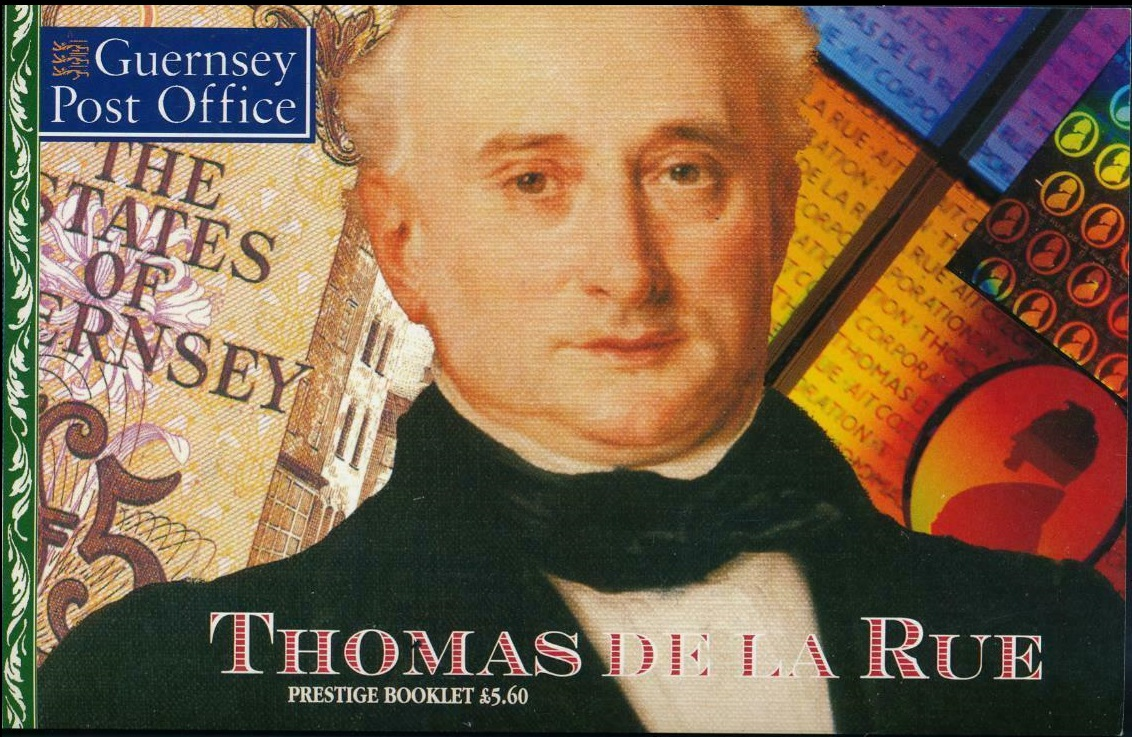
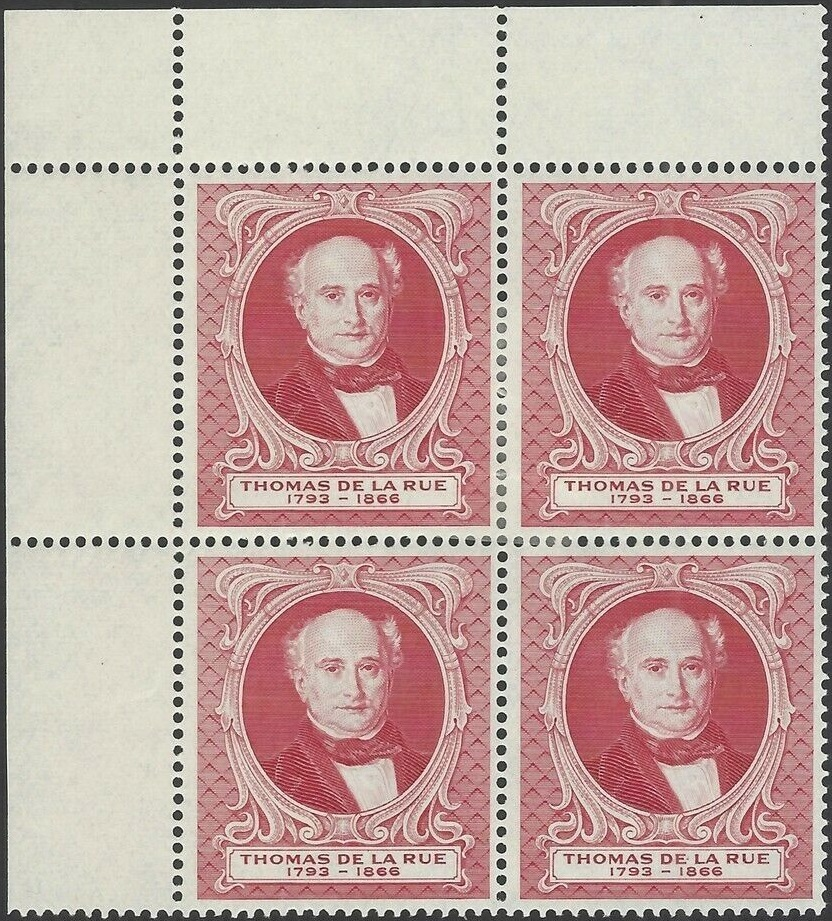
The cover of a Guernsey prestige booklet published in 1993 features the portrait of Thomas de la Rue, the founder of one of the world’s largest and most important printing companies for securities, banknotes, and stamps. Thomas was born on March 24, 1793, on the island of Guernsey in Le Bourg, a village just south of the island’s current airport. This immediately explains Thomas’s French name, as many villages and towns in the Channel Islands have French names, and many families also bear French names. At that time, French was more widely spoken than English on the islands just off the Normandy coast. The French call the islands “Îles Anglo-Normandes.” The English call them “Channel Islands.”
Thomas was the seventh child of his parents, Rachael Allez and Eleazar de la Rue. At the age of ten, he apprenticed with master printer Joseph Antoine Chevalier in Saint Peter Port, the capital of the island of Guernsey. There, he learned the printing trade and, with his expertise and financial support from Tom Greenslade, published a newspaper called “Le Publiciste.” However, a rift soon developed between the two owners, and Thomas began printing his own newspaper, “Le Miroir Politique,” on February 6, 1813.
On March 21, 1816, he married Jane Warren, and in 1818, Thomas de la Rue and his family moved to London to start a completely new business. Not a printing house, but a factory where straw hats were manufactured, an item that was very fashionable at the time. The business flourished, and the businessman Thomas, along with the British Samuel Cornish and William Rock, established another new company as “printers and book binders.” In 1828, he began operating a bookstore and manufacturing luxury goods using printing presses.
In 1831, De la Rue was granted the right to print playing cards, which was converted into a patent by the British King William IV in 1832. Before that, playing cards were printed with woodcuts in blocks using black ink. The images were then colored by hand. De la Rue was the first company in London to produce playing cards using a completely new typographic process. Demand for playing cards increased from bookstores and pubs, and many clubs were formed with card players as members.
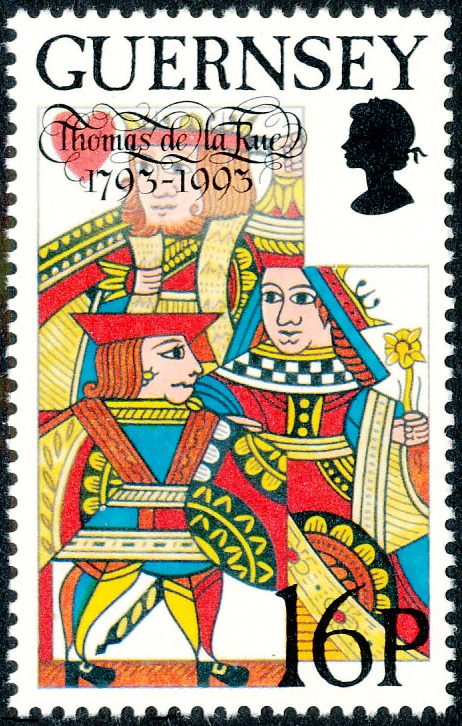
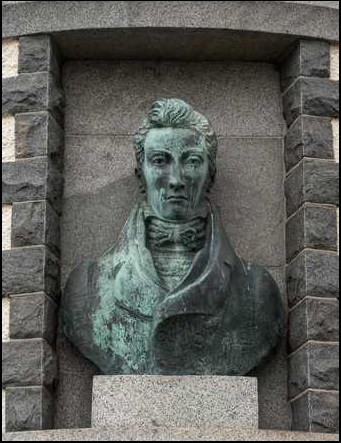
At The Pollet in St. Peter Port, there’s a pub called The Thomas de la Rue. A bust of De la Rue is incorporated into its facade. Due to the enormous demand and desire for decks of cards with a wide variety of back images and themes, he hired Owen Jones as a graphic designer. Over the next twenty years, De la Rue produced 173 different stocks of playing cards, ranging from floral and fruit themes to Chinese motifs. De la Rue thus became known as the “father of the English playing card.” From 1837, his wife and two sons worked in the business. To celebrate the coronation of Queen Victoria, he printed a special edition of The Sun in gold print. The 16p stamp pictured above was the first in a series of five issued on July 27, 1993.
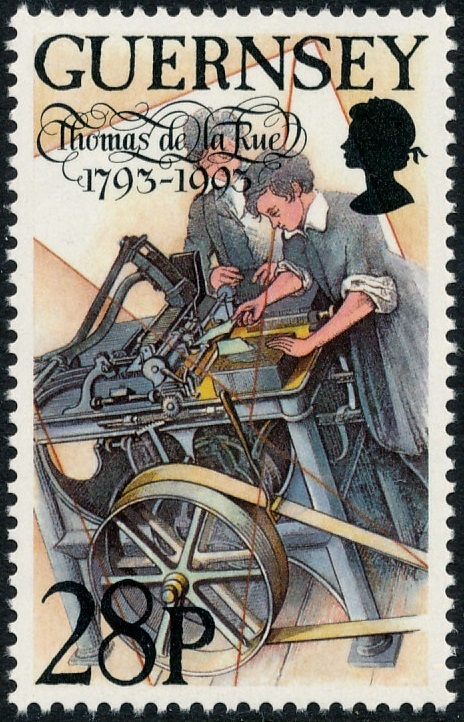
In 1848, his son, Warren de la Rue, invented the envelope folding machine. This machine, depicted on the 28p stamp, could produce 2,700 envelopes per hour. It was one of the main attractions at the Great Exhibition of 1851 at Crystal Palace in London.
Thomas de la Rue began printing revenue stamps in 1853 when he received a contract from the British Board of Inland Revenue to produce gummed stamps and perforate them. This laid the foundation for the later production of many millions of stamps.
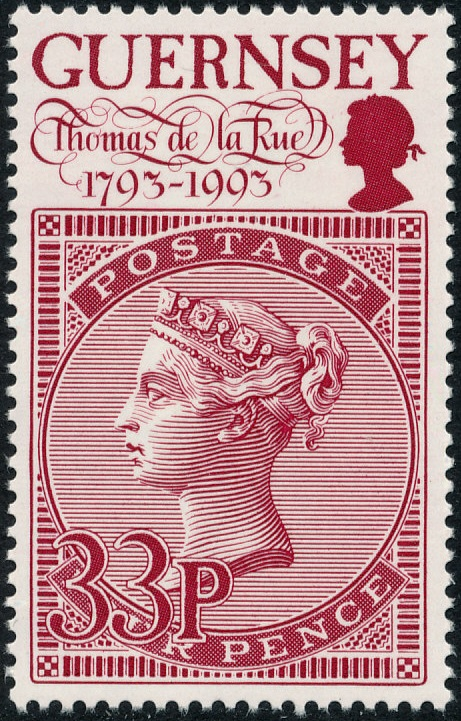
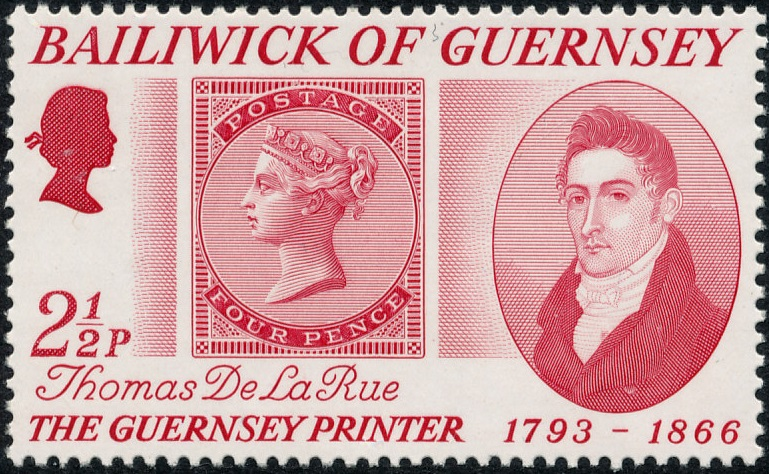
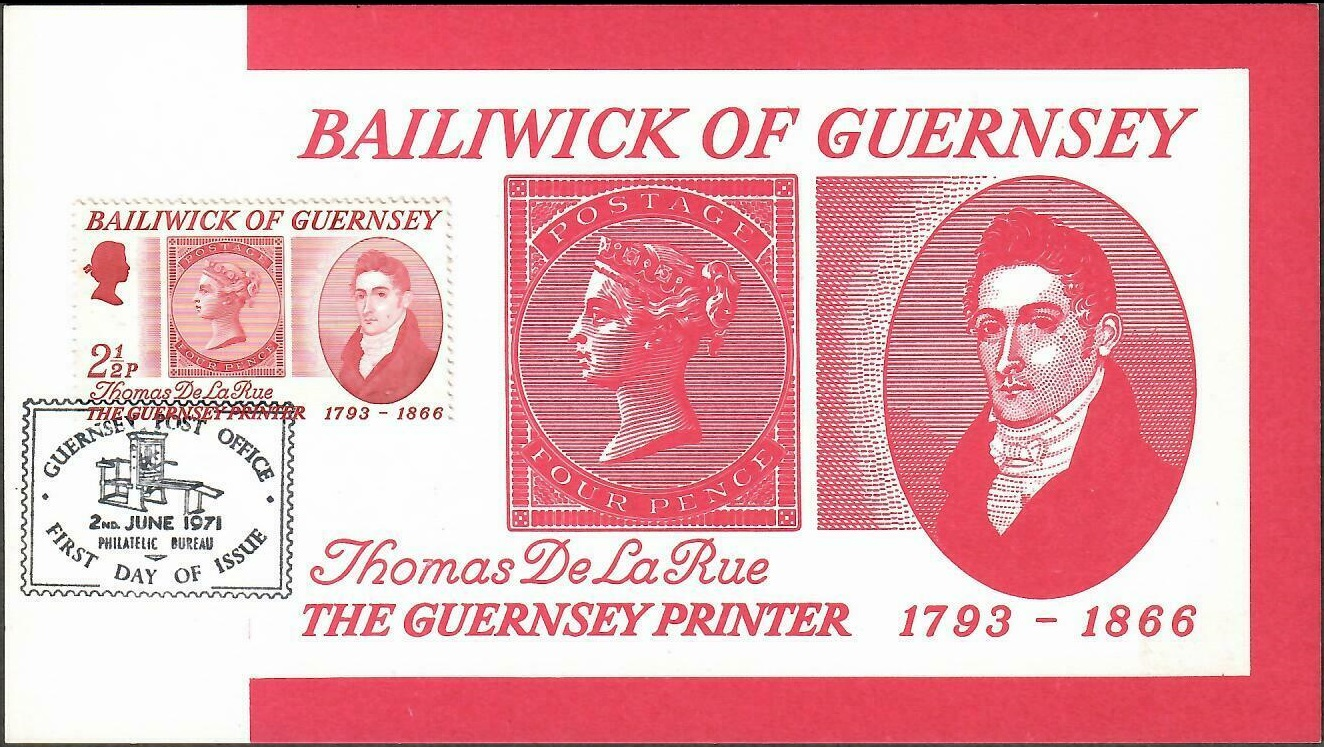
The first order for stamp printing was for the four-pence stamp depicted in the examples above. This letterpress-printed stamp was first available on July 31, 1855. Orders from Britain’s many colonies followed.
The stamp for the first day of issue depicts one of the first printing presses used by Thomas de la Rue for printing postage stamps. The 2½p stamp was one of four in the series issued on June 2, 1971.
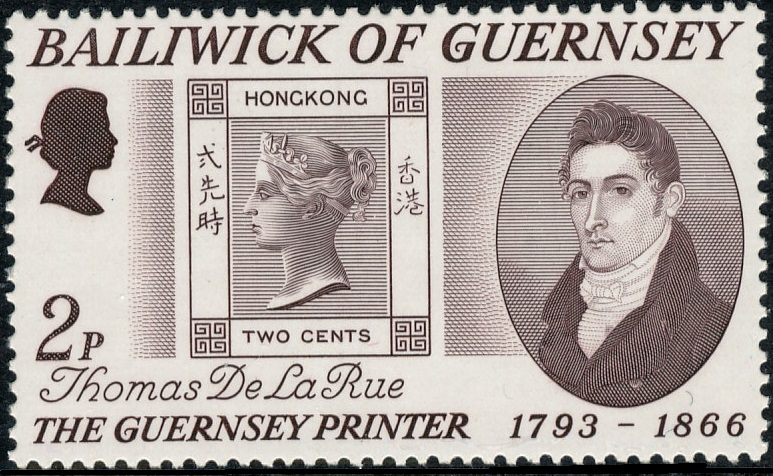
De la Rue printed stamps for the Cape of Good Hope, including the familiar triangle stamps, Mauritius, Western Australia, Trinidad, Ceylon, Hong Kong, Saint Helena, the Bahamas, Natal, Saint Lucia, and other colonies and dominions.
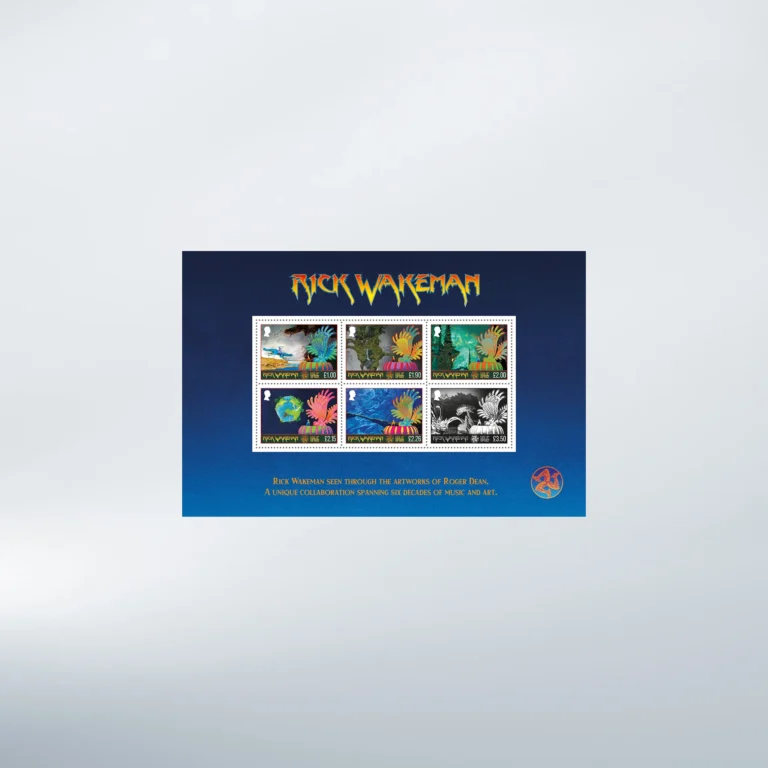
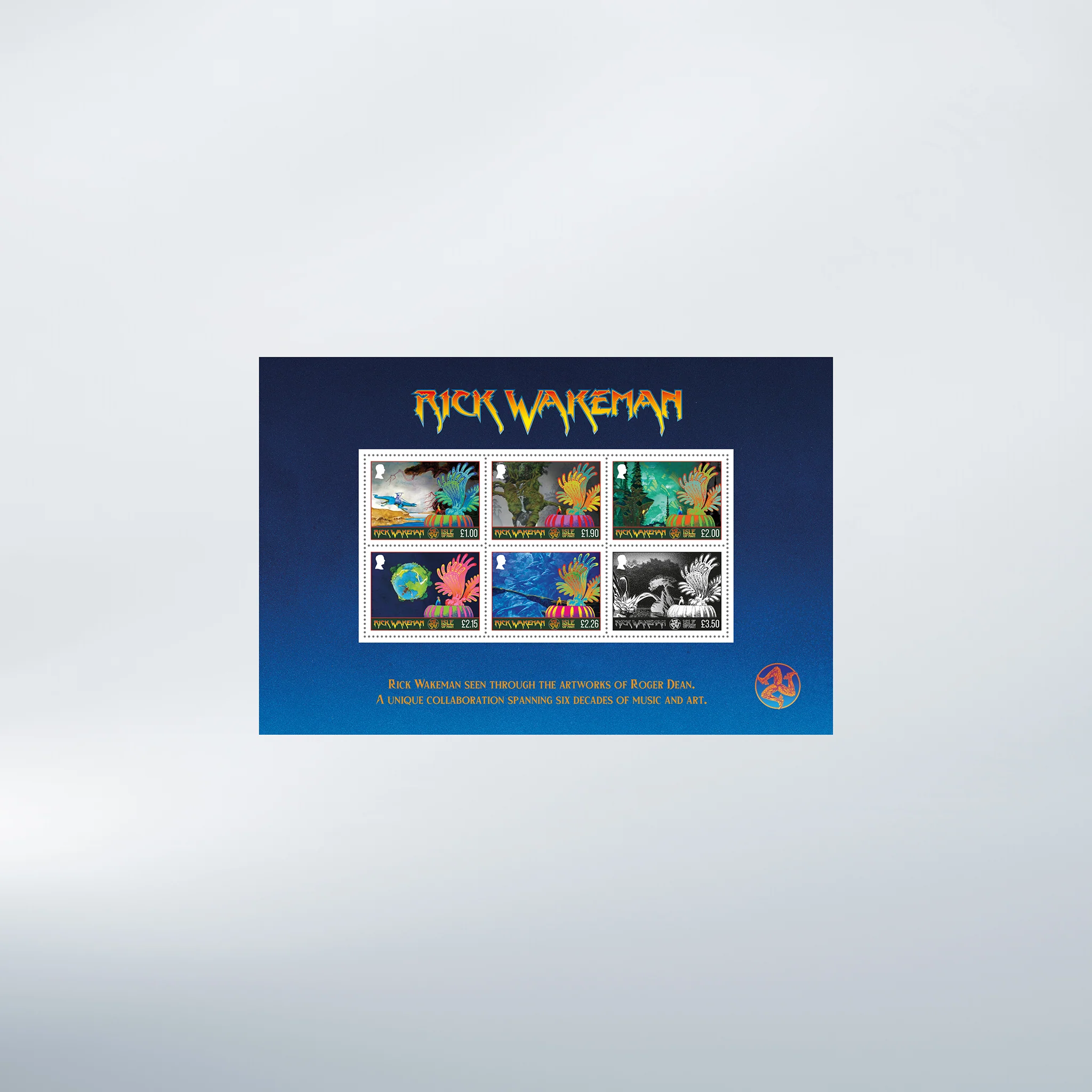
Two giants of progressive rock have come together in a landmark collection of six stamps issued by the Isle of Man to celebrate the legendary British musician Rick Wakeman brought to life through the surreal artwork of his great friend Roger Dean.
Isle of Man 2025. Image courtesy of IOM Post Office
Above you can see a minisheet and below is the presentation pack issued by the Isle of Man Post Office.
Isle of Man 2025. Image courtesy of IOM Post Office
Rick Wakeman has made more than 120 albums and continues to perform and record. From his spellbinding solos with the band YES to epic concept albums like The Six Wives of Henry VIII and Journey to the Centre of the Earth, Rick Wakeman has been pushing musical boundaries for over five decades. Each of the six stamps features a carefully selected Roger Dean illustration, capturing the otherworldly spirit and imagination that Wakeman’s music evokes. Roger Dean commented: “This is the third time I have worked with Isle of Man Post Office to produce a collection. This time, the collection is celebrating Rick Wakeman, who lived for many years on the island.” The designs on the stamps are either Rick’s solo album covers or YES album covers, produced when Rick was in the band.
A small selection of stamps added to PostBeeld’s stock recently can be seen below. Please note:for each country featured in the article, there will have been many more stamps added to PostBeeld’s freestampcatalogue.com website.
St. Vincent 1975St. Vincent 1976
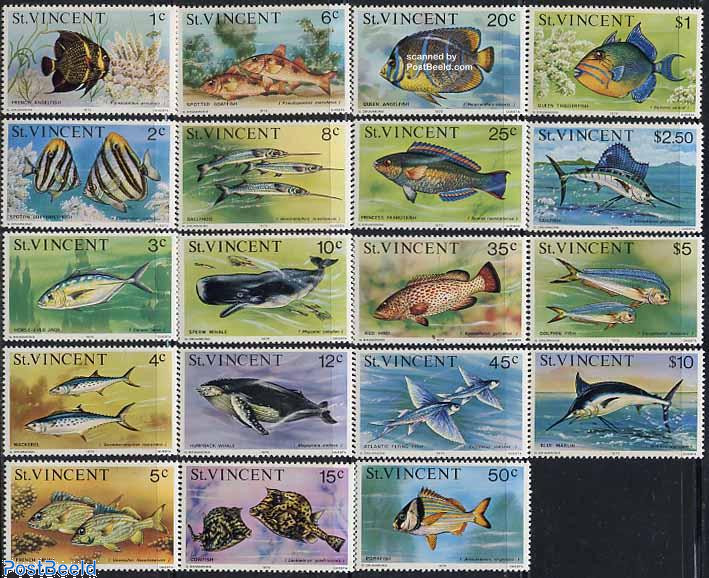
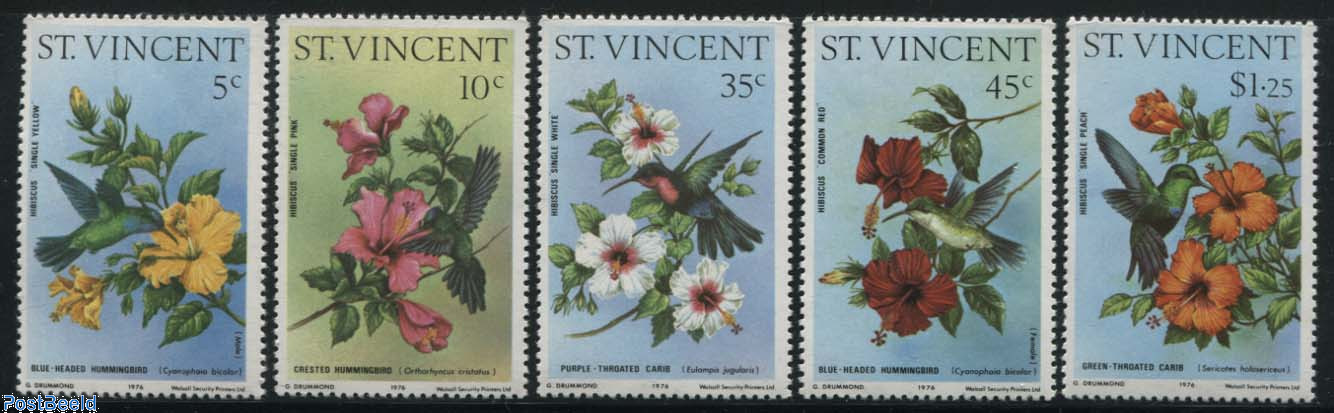
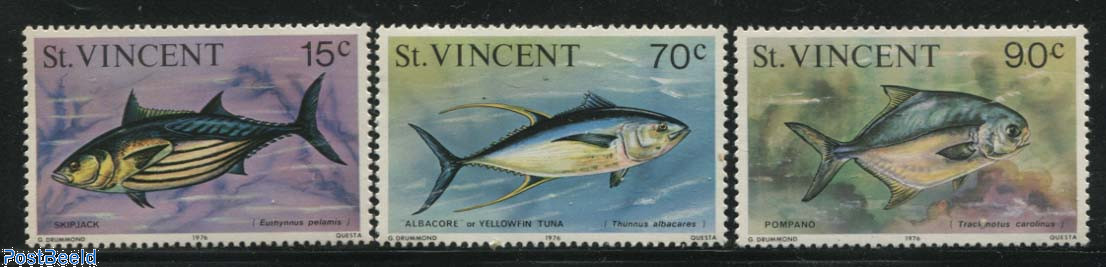
We begin with stamps from St. Vincent. Saint Vincent and the Grenadines lies to the west of Barbados, south of Saint Lucia and north of Grenada in the Windward Islands of the Lesser Antilles, in the Caribbean Sea. Above is a 5-value set featuring hummingbirds and different varieties of hibiscus flowers. Below three finely illustrated fish stamps from 1976 and a great set of definitives from 1975, also depicting a variety of fish.
St. Vincent 1976
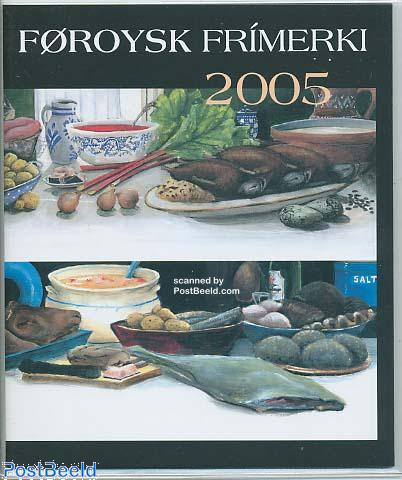
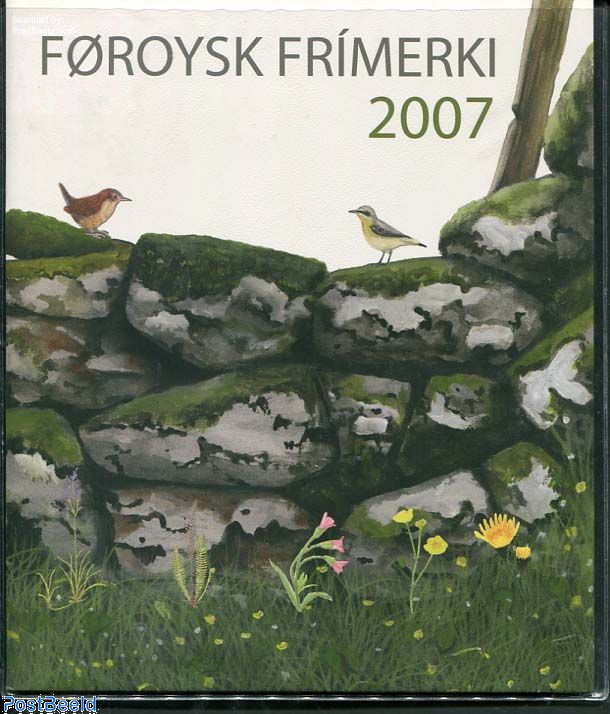
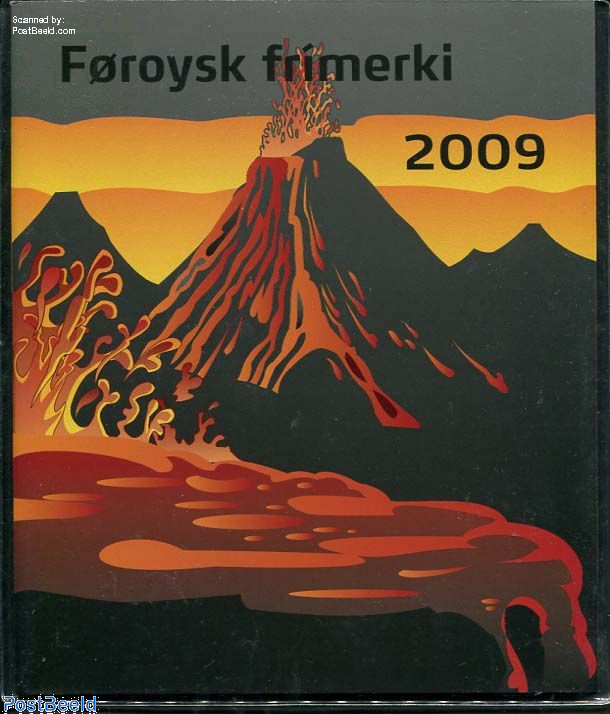
Then we have a great selection of mint Official Yearsets from the Faroe Islands, of which three are shown here.
Above and below two mint condition minisheets issued by Gambia in 1991 with wildlife found in that country.
The Gambia 1991
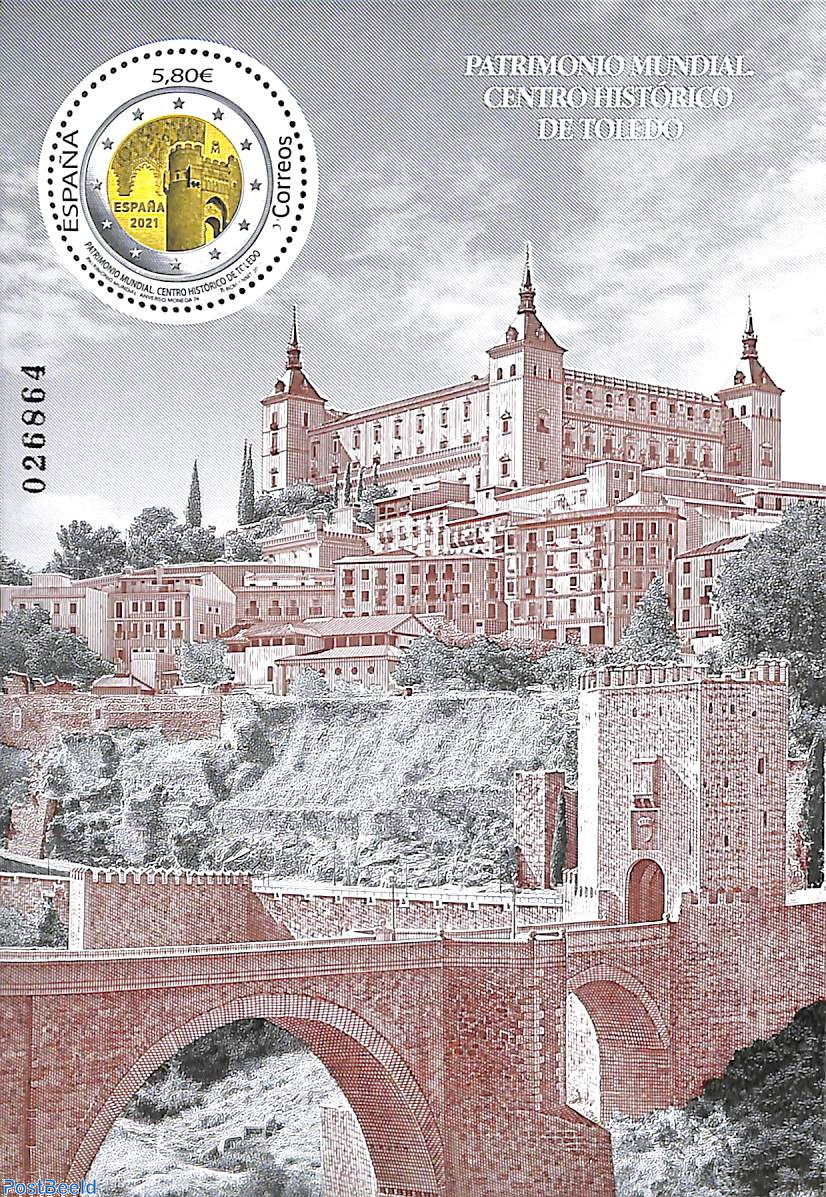
The city of Toledo is located in central Spain, 70 km south of Madrid. It is the capital of the province of Toledo and of the autonomous community of Castile-La Mancha. It was declared a World Heritage Site by UNESCO in 1986 for its extensive cultural and monumental heritage as one of the former capitals of the Spanish Empire and place of coexistence of Christian, Jewish, and Moorish cultures.
Spain 2021Spain 2020
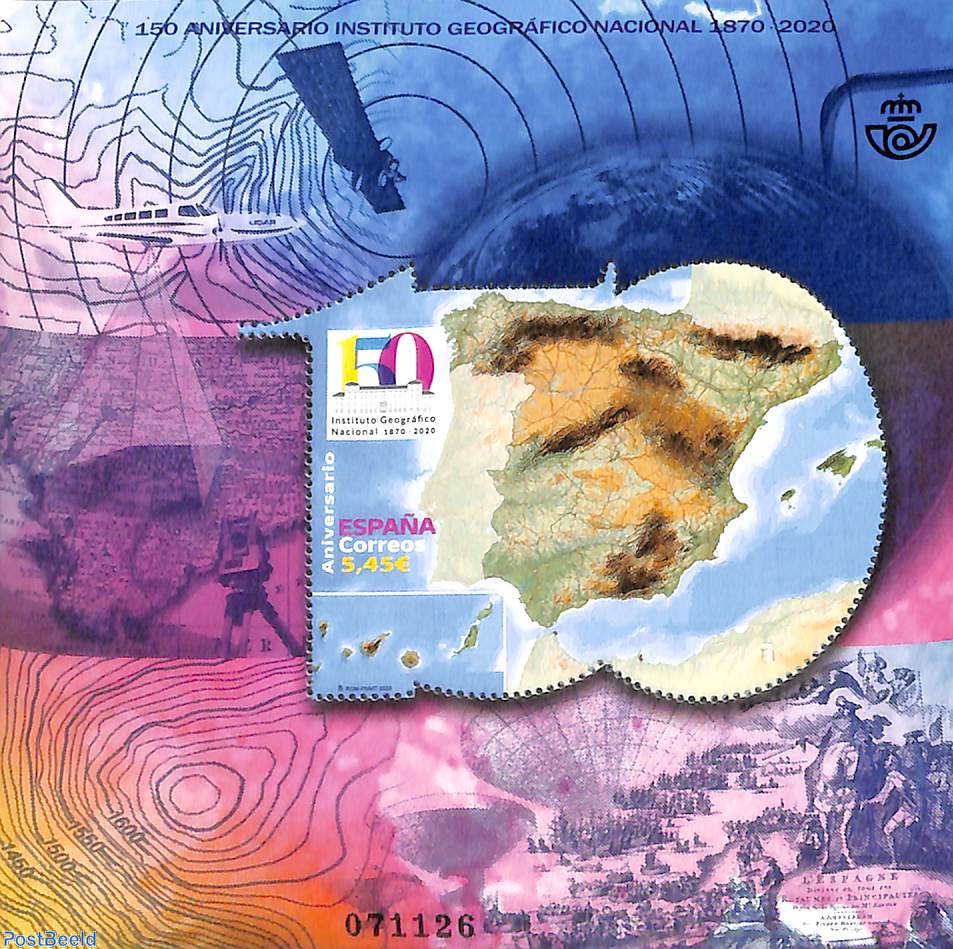
In 2020, the Spanish National Geographic Institute (IGN) celebrate its 150th anniversary. Since its creation on 12 September 1870, it has carried out 150 years of intense work – full of projects, ideas, tasks and results – always with the interest of society at heart, measuring and representing the world that surrounds us. Its work began by determining the shape and dimensions of the Earth, the production of maps and land registries, and management of the official weights and measurements system to end up including, in the twenty-first century, the most advanced technologies in the fields of Astronomy, Geodesy, Geophysics, Cartography and Geomatics. This beautifully designed stamp minisheet was issued to commemorate the anniversary.
Great Britain 2023
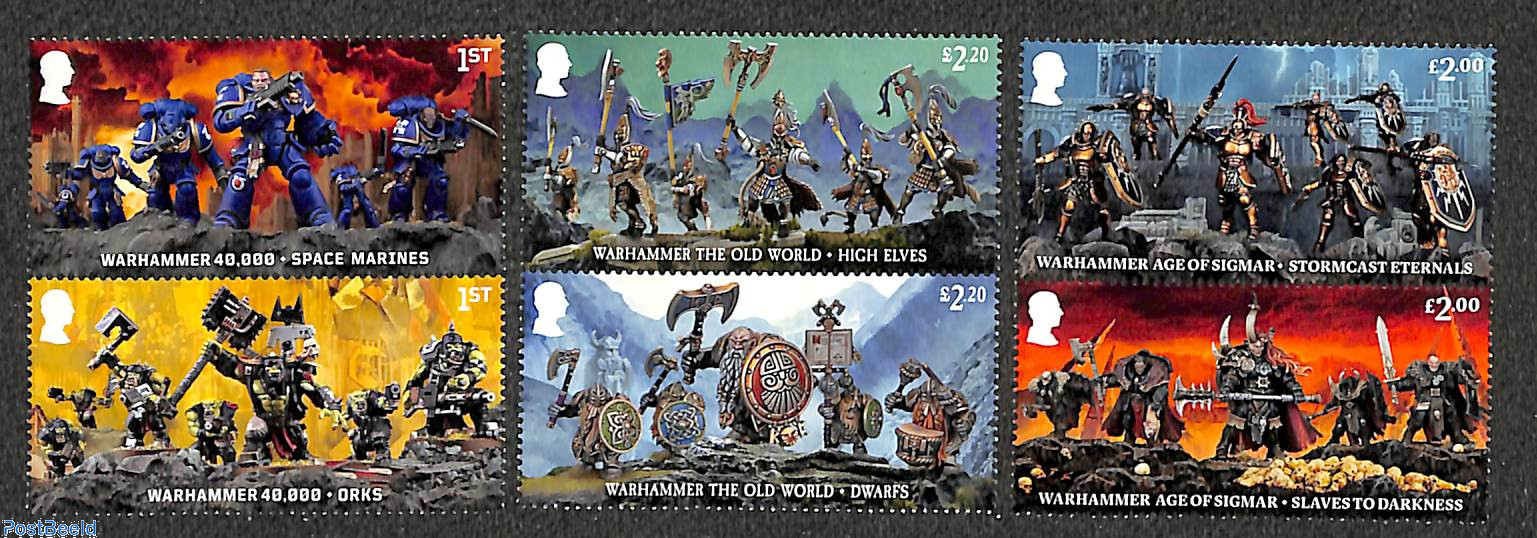
Part of Great Britain’s 2023 stamp issuance programme included the stamps seen above and below. Above, six stamps featuring the popular game/hobby Warhammer. Warhammer produces highly detailed miniatures figures that represent the characters and warriors of its settings. Hobbyists use the figures in various ways – by mustering an army for playing games, building and painting the miniatures to create their own scenarios.
Great Britain 2023
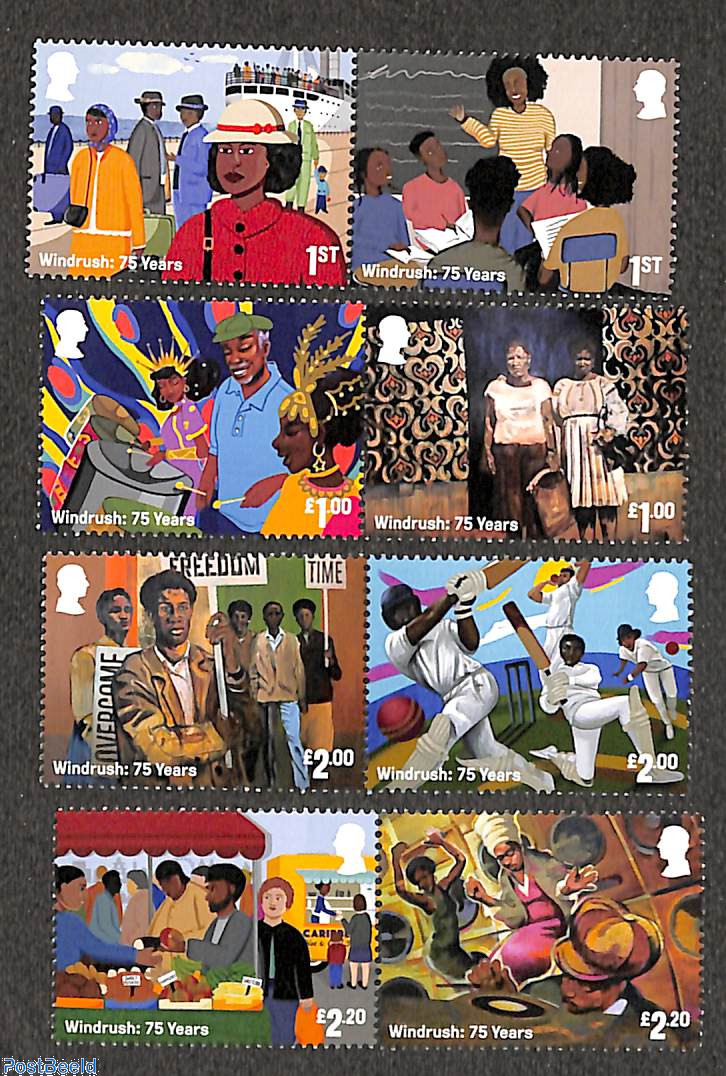
Superbly-created colourful graphics for the stamps commemorating the 75th anniversary of the arrival of the ship HMT Empire Windrush in England.The ship is best remembered today for bringing one of the first large groups of post-war West Indian immigrants to the United Kingdom. The ship carried 1,027 passengers and two stowaways on a voyage from Jamaica to London in 1948. Of these, more than 800 passengers gave their last country of residence as somewhere in the Caribbean. The Windrush’s arrival has become symbolic of the generation of British Commonwealth citizens who came to live in Britain between 1948 and 1971.
Great Britain 2023
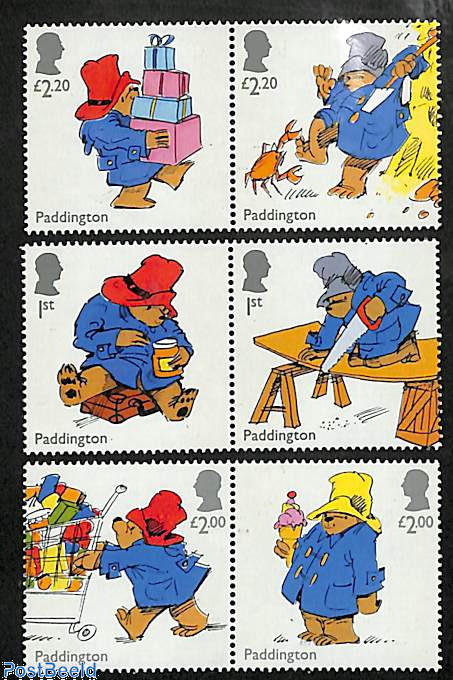
Michael Bond (1926-2017) was the author of the books introducing the character of Paddington Bear to the world. The ever-popular and instantly recognisable character is depicted on the stamps seen here. Since the first book’s publication in 1958, the Paddington books have sold more than thirty-five million copies worldwide and have been translated into over forty different languages, including Latin. To date three extremely successful Paddington Bear films have been made.
The Black Heritage series stamp issued by the United States in 2024 features Constance Baker Motley (born September 14 1921, died September 29 2005), who was the first African-American woman to become a US federal judge – being appointed by President Lyndon B. Johnson to the United States District Court for the Southern District of New York on January 25, 1966. She was also the first black woman to be elected to the New York state senate. Among many other groundbreaking achievements, she was also the first woman – of any race – to become president of one of the five boroughs that make up New York city, in her case Manhattan. Motley is widely acknowledged as a major figure in the Civil Rights Movement, especially its legal battles.
United States of America 2024
Motley was a key architect in the fight for desegregation in the South. From 1945 to 1964, Motley worked on all of the major school desegregation cases brought by LDF (the Legal Defense Fund). She led the litigation of the case that integrated the University of Georgia and directed the legal campaign that resulted in the admission of James H. Meredith to the University of Mississippi in 1962, paving the way for the integration of universities across the south. Motley claimed her greatest professional achievement was the reinstatement of 1,100 Black children in Birmingham who had been expelled for taking part in street demonstrations in the spring of 1963. Motley faced the danger of her work head-on — from driving through Ku Klux Klan territory to defend the right of Black students to attend the University of Georgia to spending hours in county jails across the deep South helping to secure the release of detained civil rights activists like Martin Luther King, Jr.
Japan’s first European trading partners were the Portuguese, who reached Japan in 1543. However, the Dutch became Japan’s sole European trading partner for nearly 250 years, starting in 1609 and continuing until Japan reopened its doors to the West. From 1633, when the Tokugawa Shogunate proclaimed the isolation of Japan, until the middle of the 19th century, the Country’s external relations and trade had been confined to China and Holland, and the only port open for these purposes was Nagasaki.
Japan 2000
In the year 2000, Japan Post issued a set of two stamps to commemorate 400 years of Japan-Netherlands relations, featuring the ancient Dutch ship De Liefde and the Dutch captain Willem Adams, which marked the first encounter between the two countries in 1600. The stamps were part of a series celebrating the anniversary of cultural exchange and the initial landing of the De Liefde in Japan.
Japan 1989
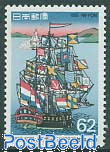
The 1989 Japanese postage stamp above depicts a 17th-century Dutch sailing ship, likely a representation of a Dutch East India Company (VOC) vessel, to commemorate the historical connection between Japan and the Netherlands, particularly through the “Holland Festival” that was held in Japan that year.
Over the coming weeks, PostBeeld delves back in time with some interesting discount offers. Each week, enjoy 5–25% off stamps from a specific era. From 19th-century classics to modern 21st-century issues — this is the perfect moment to expand your collection at a discount! Discount periods: Sep 18 – Sep 29 – stamps up to 1899 Sep 26 – Oct 6: stamps from 1900 to 1919 Oct 3 – Oct 13: stamps from 1920 to 1939 Oct 10 – Oct 20: stamps from 1940 to 1959 Oct 17 – Oct 27: stamps from 1960 to 1979 Oct 24 – Nov 3: stamps from 1980 to 1999 Oct 31 – Nov 10: stamps from 2000 to 2019 Note: On weekends, discount periods overlap. That means on Saturdays and Sundays, you’ll often get discounts on stamps from up to four different decades at once!
In 1948, Chile issued a series of postage stamps celebrating the centenary of French botanist, naturalist, and explorer Claude Gay’s book – “Flora and Fauna of Chile” – which featured various native animals and plants illustrated by the author.
Chile 1948
Three 25-stamp sheetlets, showcasing the diverse wildlife of Chile were issued with values of 60 Centavos, $2.60 and $3. As I write PostBeeld has one mint, never-hinged complete series of this rather rare issue in stock.