Here’s an interesting article PostBeeld’s owner Rob Smit added to PostBeeld’s Dutch website Postzegelblog:
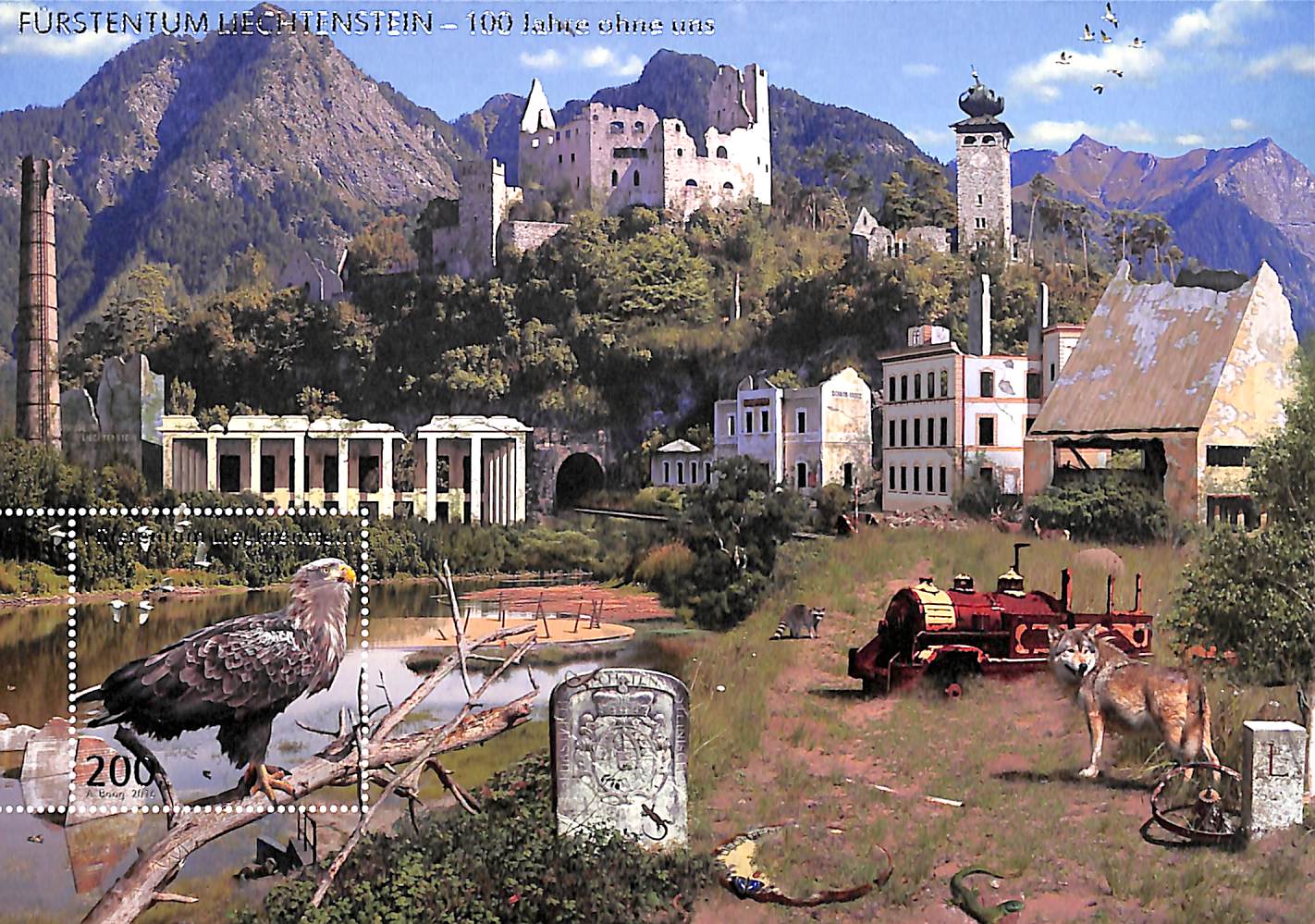
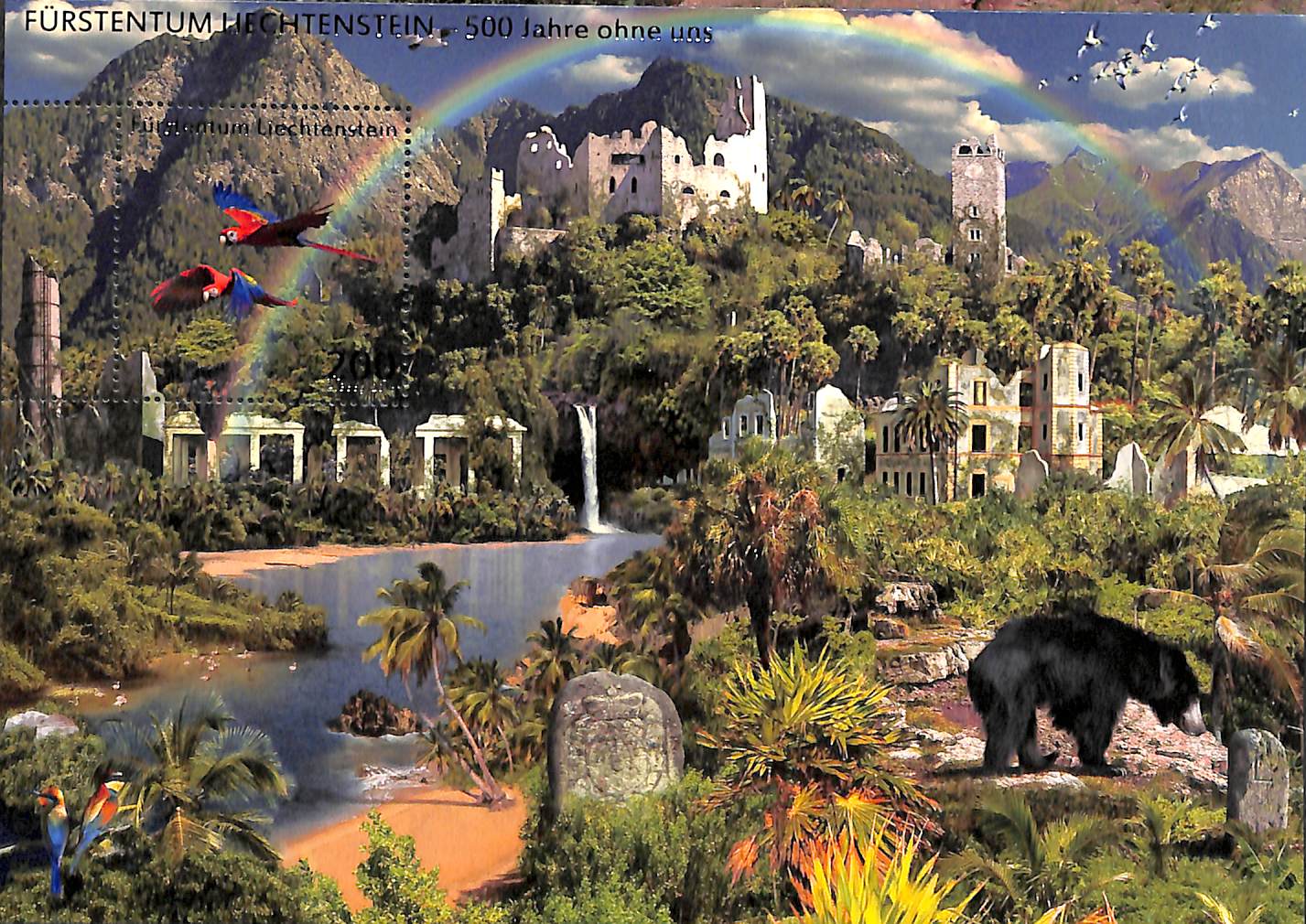
I’m often asked what I consider the most beautiful stamp. I’m not sure if I actually find it the most beautiful, but I certainly find the Liechtenstein stamps below to be the most fascinating. Every time I hold them, I’m fascinated by their appearance and comparisons. I’m referring to three Liechtenstein stamp sheets. Issued together as a sort of leaflet in 2016, the sheets depict several iconic sights of Liechtenstein, all from the same vantage point. But what’s unique is that they assume humans are extinct. The stamps were designed by the Swiss artist Pierangelo Boog, born in 1957. The first shows an imagined scene after 20 years.
Liechtenstein 2016
The second, below, shows how the landscape could change after 100 years.
And the third is what it could look like after 500 years with nature recovering to reclaim the land.
Liechtenstein 2016
The series also reminds me of my childhood, when we had a set of seven posters hanging in our elementary school classroom that made a deep impression on me. They depicted a period of just 20 years (1953-1972). It began with a beautiful house in a charming Swiss landscape, around which all sorts of things were built in subsequent posters. Eventually, the house fell into increasing disrepair and was demolished. In the final poster, the landscape had transformed into a densely built-up area with a busy highway, and the cat that could be found somewhere on each poster lay run over by the roadside. Perhaps other readers have seen these posters by Jörg Müller and remember them, or click here to view them. Notwithstanding, we are all familiar with similar developments in our own environment and thoughts.
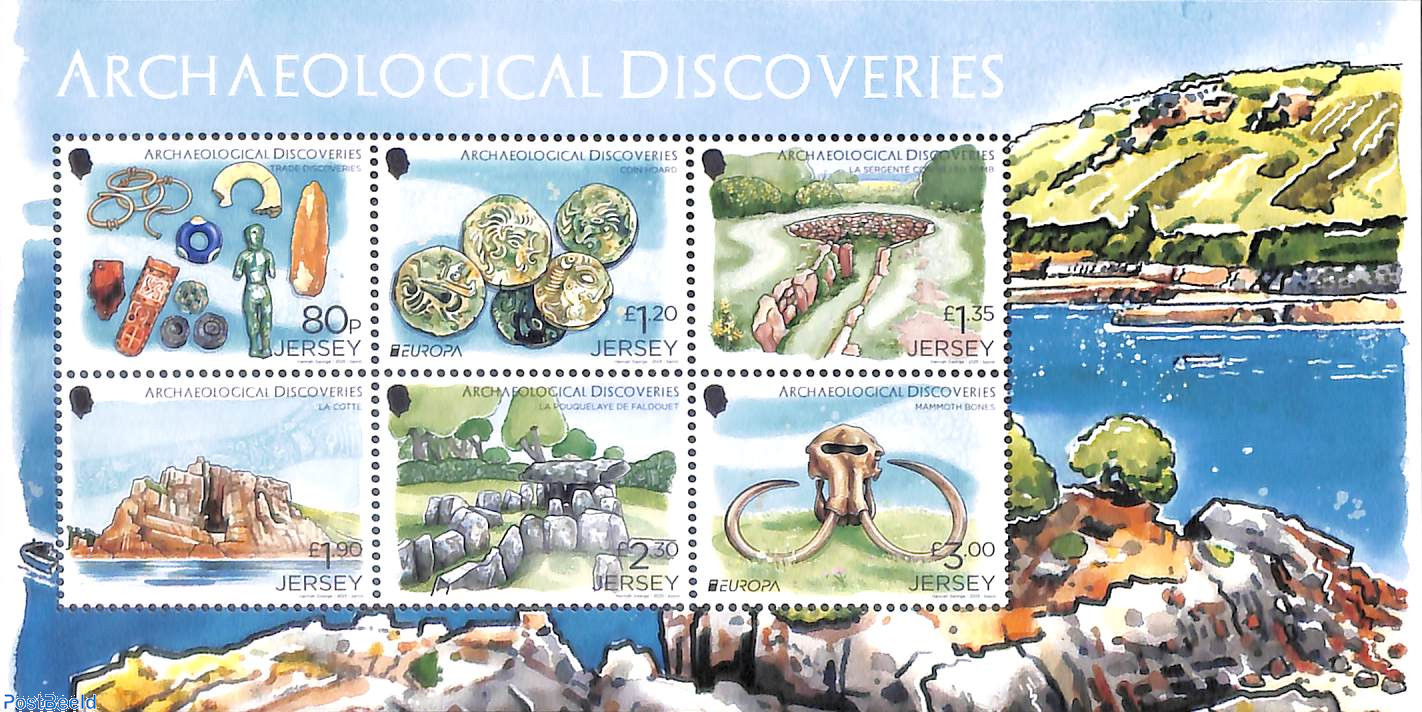
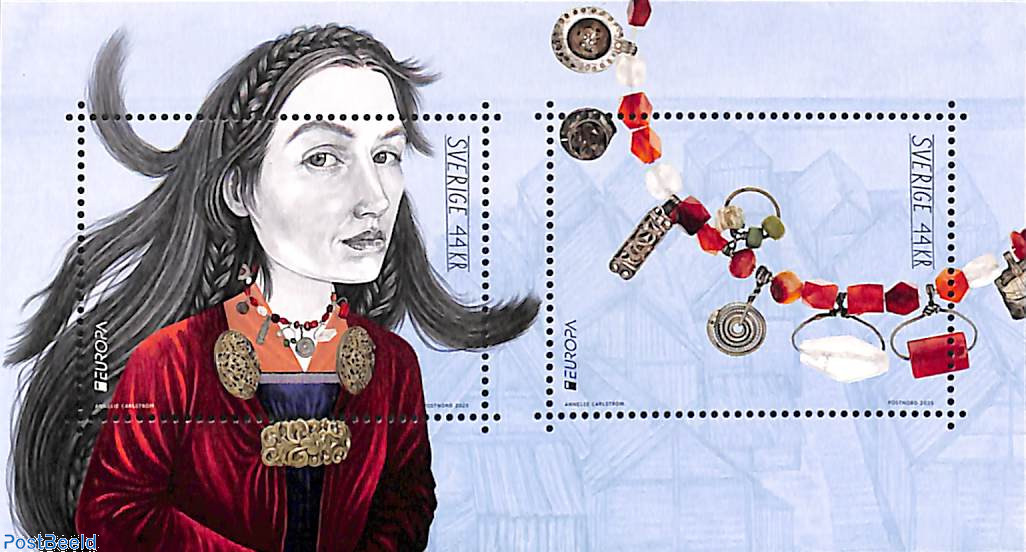
“National Archaeological Discoveries” is the theme for EUROPA stamps this year. Here we have some fine examples:
Jersey 2025
The British Channel Island of Jersey has this stamp sheet. Illustrations by British artist Hannah George, who used a combination of watercolour, ink and digital processing to create the beautiful artwork for this issue. Despite Jersey’s geographical size, it’s location within the Channel and close connection to France during the Ice Age makes it a hidden treasure chest filled with extraordinary archaeological finds, some of which are featured within the issue.
Sweden 2025
Sweden release its EUROPA stamp featuring a “Protective Necklace” discovered in a Viking burial site in Birka, on the island of Björkö in Lake Mälaren. The stamp depicts a necklace with charms, rock crystals, and carnelians, highlighting the Vikings’ long-distance trade.
Romania 2025
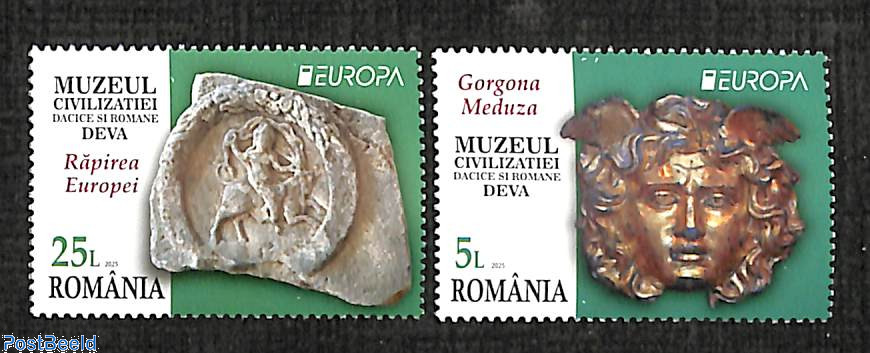
These stamps from Romania feature two unique artifacts discovered during archaeological excavations at Ulpia Traiana Sarmizegetusa and Vețel: a gilded bronze applique of Medusa the Gorgon and an image of The Abduction of Europa by Zeus.
Malta 2025
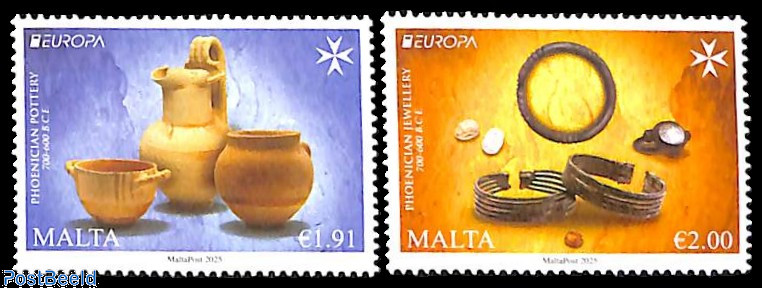
Malta’s EUROPA issue shows artifacts extracted from Phoenician tombs recently discovered at Għajn Klieb, an archaeological site in Rabat, Malta.
Liechtenstein 2025
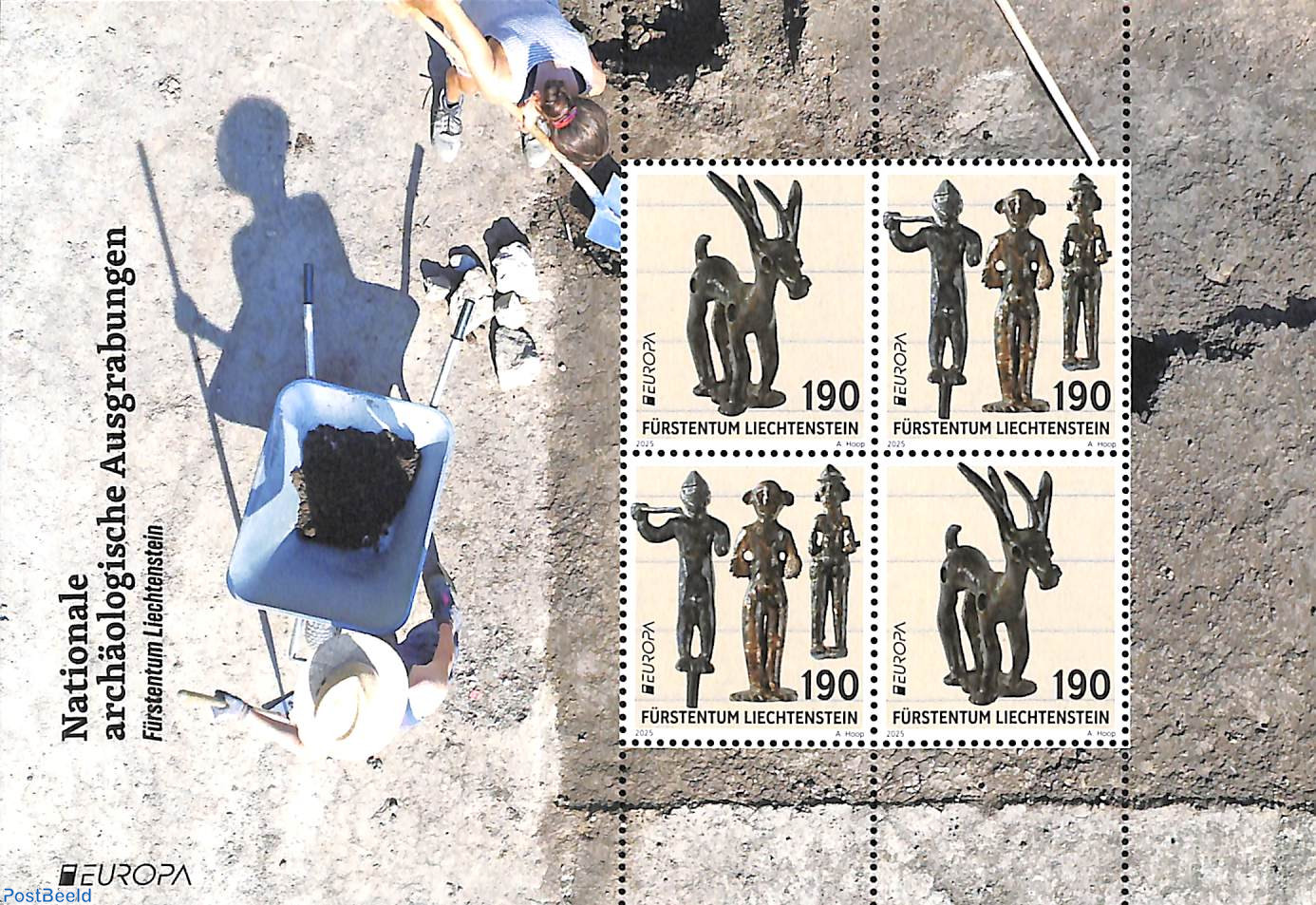
Liechtenstein’s stamps depict four of ten votive figures (small statues or figurines offered to deities, often in temples or sacred spaces, as a form of prayer, dedication, or gratitude) found on the Gutenberg castle hill in Balzers, dating back to the Late Iron Age. The background photograph showing people working at the excavation site.
Åland 2025
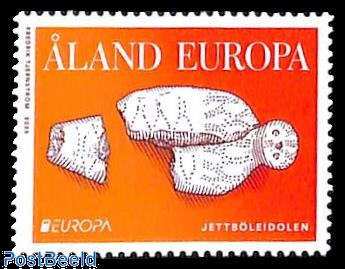
The Åland Islands issued a Europa stamp celebrating the discovery of the Jettböle Stone Age settlement. This settlement, discovered in 1906, significantly impacted the understanding of Åland’s prehistoric past. The stamp features the Jettböle idol, a symbol of this Stone Age site.
PostBeeld’s owner, Rob Smit, has a great collection of all sorts of things related to philately and its history. This article doesn’t feature actual stamps but focuses on something that has previously appeared in Rob’s series of stories “The History of Stamp Collecting”.
The Paris stamp market, La Bourse Aux Timbres, is the oldest stamp market in the world and still exists. It’s located very close to its original position, just off the Champs-Élysées near Avenue de Marigny. The market originated around 1860. As mentioned, this blog post doesn’t feature stamps, but rather some nostalgic postcards from Rob Smit’s collection.
In 1941, during the exhibition “L’Art dans le Timbre,” two postcards featuring illustrations of the stamp market were published. One depicted the market in its early days, around 1860, and one depicted the market as it looked at that time – 1941, when France was occupied by Nazi Germany in the Second World War.
The first postcards with photographs date from the early 20th Century. Trading was primarily done by sellers standing or placing their items on chairs. And it certainly wasn’t exclusively men!
By the 1920s, the market became busier and busier.
In the 1930s and 1940s, it became a little more comfortable to sell from folding tables instead of chairs.
The last photos from Rob's collection date from the 1970s when, as can be seen below, Still, chairs were still being used as sales stands.
As mentioned, the market still exists. With a little effort, you can find many more beautiful old and more modern pictures by searching online.
The 1944 Amateur World Series, also known as the 7th Amateur World Series, was held in Caracas, Venezuela and the host country won their second Amateur World Series at the event. However, the competition was marred by some controversial umpiring decisions, seemingly in favour of Venezuela. The air mail stamp definitive set above was issued to commemorate the occasion.
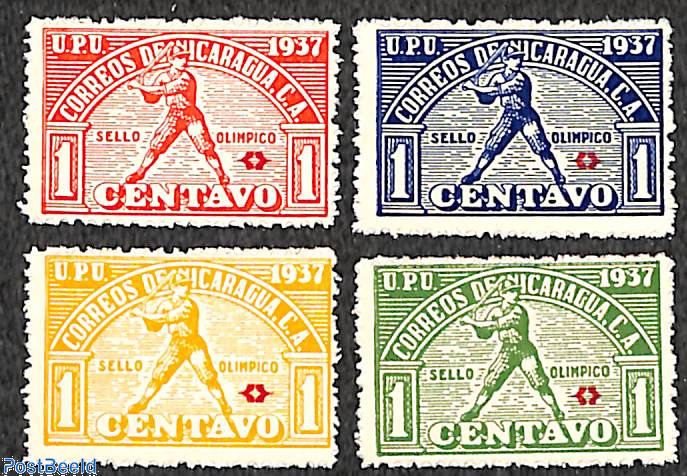
Nicaragua 1937
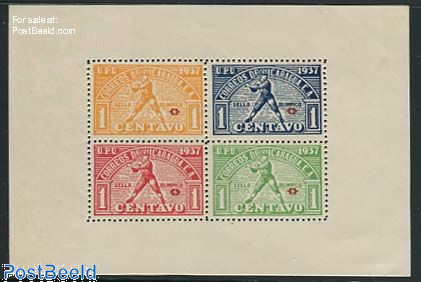
The stamps above, and the souvenir sheet below were issued in 1937. They were produced for the Central American and Caribbean Games to be held in Panama in February 1938. Cuba attained the baseball competition gold medal, beating Panama in the Final, Nicaragua won the bronze medal.
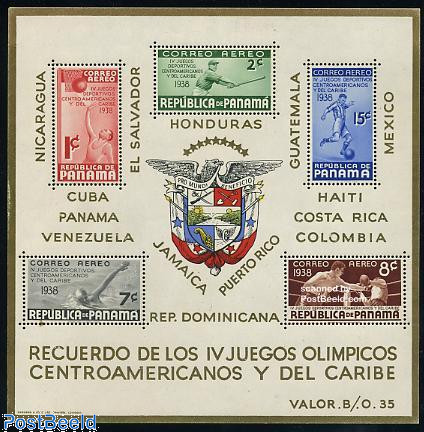
Nicaragua 1937Panama 1938
The fourth Central American and Caribbean Games were held in 1938 in Panama City. Ten countries competed and the baseball gold medal was won by Cuba. The commemorative stamp sheet issued by Panama depicts five of the events at the Games, including baseball.
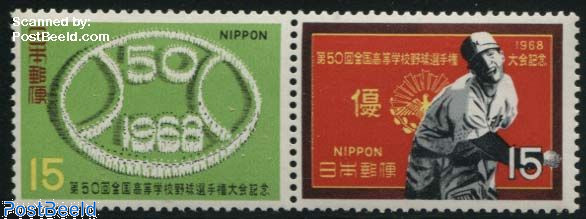
Japan 1968
Two special 15-yen postage stamps were issued by Japan in 1968 to celebrate the 50th All-Japan High School Baseball Championship Tournament. The first stamp features numerous players clad in white jerseys, arranged to form a baseball shape. This unique design incorporates the number ’50’ and the year ‘1968’, highlighting the 50th-year anniversary of the tournament. The stamp on the right depicts a baseball pitcher with the championship flag in the background.
Cuba 1968
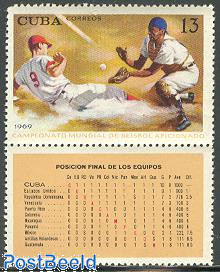
The 17th World Series of Amateur Baseball took place in the Dominican Republic in 1969. The team from Cuba won the competition and the stamps shown here were issued to celebrate the victory. The top stamp shows a Cuban player completing a run as the United States team’s catcher waits for the thrown ball to reach him. The attachment displays the league table, with Cuba in top position. Cuba’s victory came 30 years after their first World Series of Amateur Baseball win in 1939.
Dominican Republic 1969
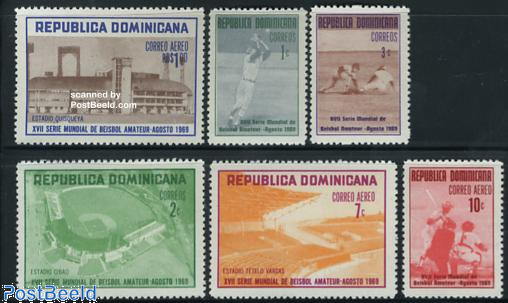
And the 17th World Series of Amateur Baseball host country the Dominican Republic produced the above stamps to commemorate the event.
Taiwan 1971Taiwan 1971
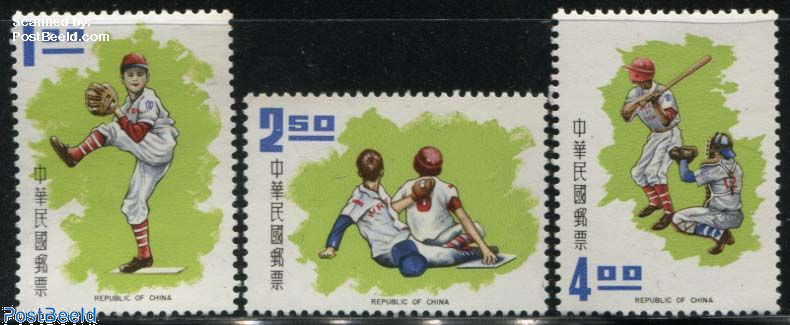
In 1971, Taiwan issued stamps to coincide with the start of the Pacific Region Competition of the 1971 Baseball World Little League Series held in Taiwan. The stamps’ designs were inspired by the uniforms of the Taiwanese team, the Golden Dragons, the 1969 Little League World Series champions.
South Korea 1982
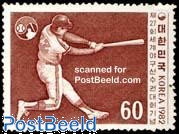
South Korea hosted the Baseball Amateur World Series for the first time in 1982. Also known as the 27th World Baseball Championship, ten nations took part and the South Korean team won the competition. The stamp seen here was part of an issue commemorating the victory.
In 2005, the Portuguese Paulo Magalhäes (a lover of sending and receiving postcards) developed a website that provides participants with random addresses to send a postcard to other postcrossers anywhere in the world. The card recipient registers the card delivery on the website, after which the system makes the sender’s address available to others who also want to send cards. This way, a postcrosser only receives cards if they send them themselves. Those who send many cards also receive many more. The appeal of postcrossing connections fosters friendships worldwide. Since 2005, more than 800,000 postal enthusiasts from 210 countries have registered on the website.
Netherlands 2025
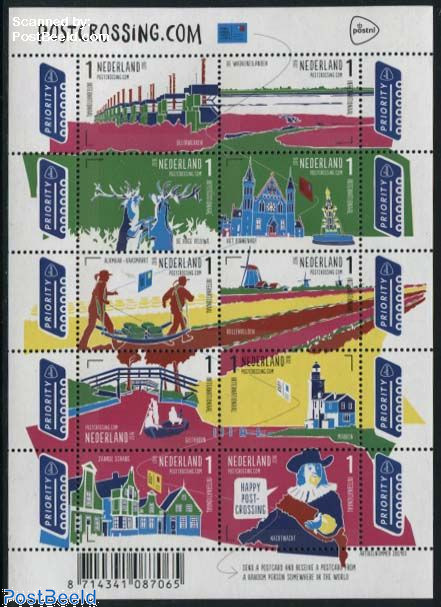
The Postcrossing 20th anniversary stamp sheet produced this year by The Netherlands consists of six identical stamps: three in a normal orientation and three inverted. An earlier postcrossing issue from The Netherlands in 2016 depicted typical Dutch scenes.
Netherlands 2016Indonesia 2017
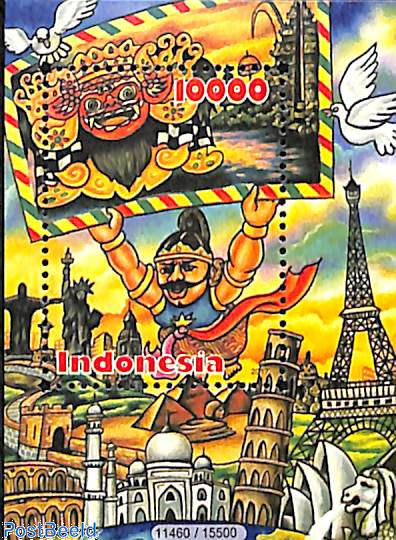
In 2017 Indonesia produced this beautifully-illustrated limited edition postcrossing stamp sheet featuring famous landmarks from around the world and the three values below.
Indonesia 2017Guernsey 2021
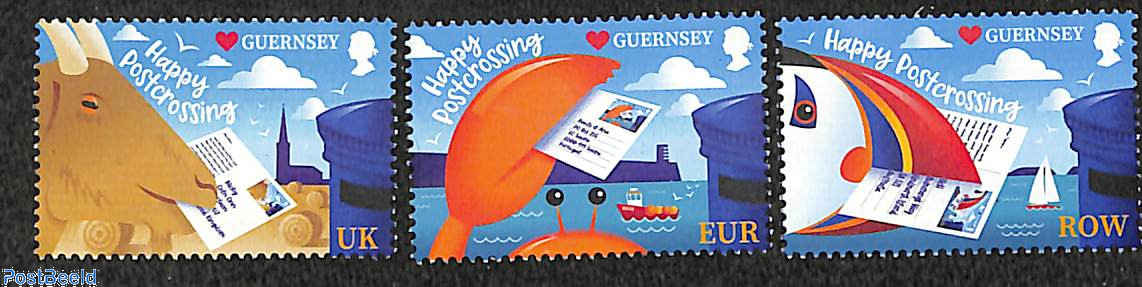
Guernsey issued three superbly designed postcrossing stamps in 2021 featuring a goat, a crab and a puffin about to place postcards in a letter box. They are intended separately for post within the United Kingdom, Europe and the Rest of the World.
Switzerland 2017
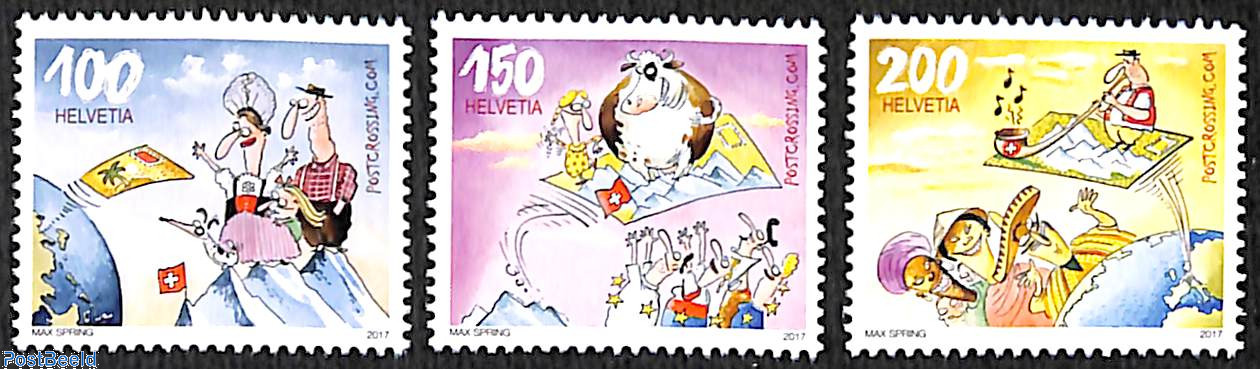
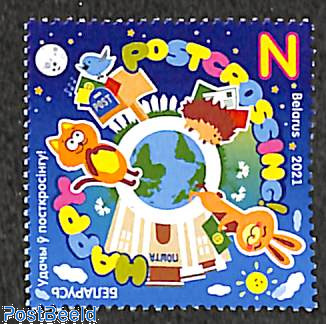
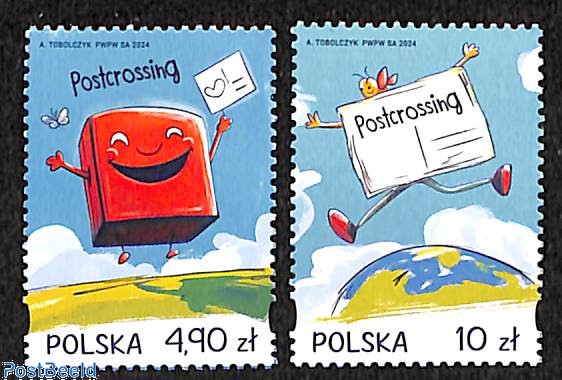
These humorous stamps were produced by Switzerland in 2017. It’s amazing how popular postcrossing has become and how it has spawned friendships worldwide since its inception. Below are examples of postcrossing stamps from Belarus, Poland and Ukraine. Check PostBeeld’s Freestampcatalogue for more items.
A small selection of stamps added to PostBeeld’s stock recently can be seen below. Please note: for each country featured in the article, there will have been many more stamps added to PostBeeld’s freestampcatalogue.com website.
Venezuela 1950
In 1950, Venezuela issued this airmail stamp series featuring the protection of the country’s flora – specifically specifically focusing on the Tabebuia Chrysantha flower shown on the stamps.
Venezuela 1951
Issued in 1951, this great set of airmail stamps from Venezuela features gas and oil facilities and the coat of arms of the State of Zulia. Zulia is one of the 23 states of Venezuela. The state capital is Maracaibo, situated in northwestern Venezuela, bordering Lake Maracaibo – the largest body of water of its kind in Latin America. Its basin covers one of the largest oil and gas reserves in the Western Hemisphere.
Great Britain 2024
Some great additions to stock from Great Britain if you check PostBeeld’s website, including this set featuring photographs of Winston Churchill at different stages of his life and some of his famous quotes. And below is a special collector’s sheet from Christmas 2024. The sheet features eight First Class stamps, eight Second Class stamps, one First Class Large Letter stamp, one Second Class Large Letter stamp and two £2.80 stamps. Each stamp features a snowy scene of a UK cathedral: Edinburgh, Liverpool, Armagh, Bangor and Westminster.
Great Britain 2024Switzerland 1986
These Pro Juventute stamps and the first day cover were issued by Swiss Post in 1986.
Switzerland 1986
The United States Postal Service issued “The Pan-American Inverts” souvenir sheet seen here in 2001. The Pan-American Exposition held in Buffalo, New York in 1901, highlighted advancements of the 19th century in industry, transportation, manufacturing, and the arts. On opening day, a series of six bi-coloured stamps commemorating the exposition was issued. A limited number of the stamp sheets were printed with inverted centres: the 1-cent stamp depicting the steamship, “City of Alpena”; the 2c stamp depicting the train, “Empire State Express”; and the 4c stamp depicting an early electric automobile. The rare inverts quickly became collectibles.
United States of America 2001
This 2001 souvenir sheet includes reproductions of the famous Pan-American inverts in their original colours as well as four reproductions of a “cinderella” stamp that originally commemorated the 1901 Pan-American Exposition. (A cinderella is an item that resembles, but is not, an official government-issued postage stamp.) The design of the red and blue, diamond-shaped cinderella features a charging buffalo in the centre with the words “Pan-American Exposition Buffalo.” The addition of an 80-cent denomination makes each of the four cinderella reproductions official postage stamps. A detail of the cover illustration from a 1901 souvenir guide also appears on the 2001 souvenir sheet. In the illustration, an allegorical female representing unity among the Americas stands on top of a globe. In her left hand she holds a flag – half-Canadian, half-American – and her right arm rests on the back of a buffalo. The globe shows the western hemisphere and includes the words “Pan-American Exposition 1901. Buffalo, NY, USA.” Niagara Falls appears in the background.
Poland 1963
The 5.60 Zloty stamp on this Polish stamp sheet from 1963, entitled Conquering Space, depicts Mariner 2 (Mariner-Venus 1962), an American space probe to Venus, and was the first robotic space probe to report successfully from a planetary encounter. The 6.50 Zt features Mars 1, the first spacecraft to fly by Mars, although communications had been lost before it reached the planet.
Poland 1962
The FIS Nordic World Ski Championships is a bienniel competition for cross-country skiing, ski-jumping andNordic combined skiing, organised by the International Ski Federation (FIS). These three rare minisheets were produced to commemorate the 1962 event held in Zakopane, Poland.
Namibia 1999
Colourful orchid stamps from Namibia issued in 1999. In value order they show: Eulophia hereroensis, Ansellia Africana, Eulophia leachii and Eulophia speciosa.
Namibia 2005
Also from Namibia three stamps, one overprinted ‘Registered Mail’ featuring vegetables and grain – from 2005.
Dubai 1967
The 1967 World Jamboree was the 12th World Jamboree of the World Organization of the Scout Movement. The camp was held in Farragut State Park, on the southern shore of Lake Pend Oreille, Idaho, in the northwestern United States. It was the second time a World Jamboree had been held in the Americas. The camp welcomed 12,011 participants from 105 countries. Dubai produced the above stamps to commemorate the event. For those interested in Scouting stamps PostBeeld has recently added a great collection to its stock, shown here are just a few.
Fujeira 1971
The 13th World Jamboree was held in Japan in 1971 and Fujeira issued a gold and silver stamp for the event during which a typhoon struck and thousands of scouts had to evacuate the camp site for 48 hours.
Sharjah 1971
Also from 1971, Sharjah featured Scouts from various European countries with accompanying famous landmarks in this set of stamps.
Vatican 1958
The Holy See’s participation in the Brussels World Fair was commemorated by a series of Vatican City postage stamps. The designs represent Pope Pius XII and the Holy See’s pavilion at the fair.
Suriname 1936
These higher value definitives from Suriname (1936), then a Dutch colony, show Queen Wilhelmina of the Netherlands who reigned for nearly 58 years (1890-1948), making her the longest-reigning monarch in Dutch history.
In 2011 Penrhyn, one of the Northern Cook Islands, issued the stamps shown here featuring the unusual subject Pearl Diving. Two species of pearl oyster are found in the Cook Islands. The small pearl oyster (pinctada maculata) – also known as pipi – is harvested on Penrhyn for its natural golden pipi pearl. Then there is the black-lipped pearl oyster which is plentiful in the Penrhyn lagoon. As they can be found in the wild attached to coral reefs as deep as 60 metres, in the past divers collected the pearl oysters. Nowadays it is more common to use farming methods such as drilling holes in the oysters and hanging on ropes set in the lagoon, as can be seen on the stamp sheet at top and below.
Penrhyn, Northern Cook Islands 2011United Arab Emirates 2005
In 2005 Emirates Post issued special stamps in five denominations – 50 Fils, 125 Fils, 175 Fils, 275 Fils and 375 Fils – the subject being ‘Tools used in Pearl Diving’. The stamps highlights tools like the nose clip, the leather gloves used for protecting the divers’ fingers from the sharp edges of the oyster shells, the basket used for collecting the oysters, the weight used for accelerating the diver’s descent into the sea and a diver’s outfit.
United Arab Emirates 2005Japan 1961
In 1961, Japan released a stamp featuring pearl divers as part of the “Minami-Boso Quasi-National Park” series. The stamp depicts pearl divers on the beach, along with a lighthouse. There is also a superb First Day Cover, see above. The items were issued to highlight the Minami-Boso Quasi-National Park in the Kantō region of Honshū in Japan.
Japan 1961Bahrain 1996
Bahrain produced pearl diving stamps in 1996. They show a dhow, divers preparing to work, a diver descending and one returning to the boat with oysters.
Bahrain 1996
And on this Bahrain souvenir sheet pearl divers’ equipment is featured.
Qatar 1998
The background of this minisheet from Qatar (1998) shows a dhow, while the stamp and its border depicts a pearl diver opening his catch.
Tonga 2002
“Pearls of the Tropics” is the title of the 2002. 90c Workers and pearls. 1p Diver and pearls. 1p20 Woman wearing pearl necklace. 2p50 Island scene and pearls.
Tonga 2002French Polynesia 1970
And beautifully illustrated air mail stamps from French Polynesia, produced in 1970, depicting various facets of pearl diving
In 2024, United Arab Emirates Dubai issued the stamp sheet shown here to celebrate the 15th anniversary of the Dubai Metro system. Opened in 2009, the Dubai Metro is one of the most advanced and impressive transport systems in the world. With fully automated, driverless trains and modern stations, it offers an efficient way to travel around the city. The network consists of two main lines: the Red and Green lines, which connect key locations such as the airport, business district and tourist attractions. Extensions were added later, including the Route 2020 line, which serves the station Expo 2020 Dubai. The commemorative block below was issued in 2024, the service’s 15th anniversary. In the early 21st century, it became increasingly clear that Dubai needed an efficient public transport system. The city was growing rapidly, and the road network was becoming increasingly busy. In 2005, the Dubai government commissioned the construction of a fully automated metro system.
United Arab Emirates – Dubai 2024
Construction began in 2006 and was led by Dubai’s Roads and Transport Authority (RTA). The project was carried out by a consortium led by Mitsubishi Heavy Industries, along with other international companies. On 9 September 2009, the Red Line was officially opened, giving Dubai the world’s longest fully automated metro. The Green Line followed on 9 September 2011, significantly expanding the network. Dubai Metro stands out for its modern infrastructure and luxurious amenities. With climate-controlled stations and trains, special cabins for women and children and premium Gold Class carriages, it fits perfectly with Dubai’s image as a futuristic city.
Collectors of butterfly stamps consider the issue seen here to be the world’s first butterfly topical postage stamp. In 1891, the Kingdom of Hawaii issued a 2¢ dull violet Queen Liliuokalani stamp. Liliuokalani (1838-1917) was the only Hawaiian queen to rule in her own right (from 1891-93), and she was the last sovereign monarch of the kingdom. The design of the 2¢ stamp features a butterfly ornament in the Queen’s hair.
Hawaii 1891Mozambique 1953
Whilst on the subject I thought I would add a few stunningly attractive butterfly stamps from the middle of the last Century. Here is a definitive set from Mozambique, produced in 1953.
Japan 1956
In 1956 Japan issued the above, depicting a Great Purple Emperor (Sasakia charonda) butterfly.
Hungary 1959
A gorgeous imperforated butterfly and moth set from Hungary, issued in 1959.
Somalia 1961
Beautiful air mail stamps issued by Somalia in 1961. Shown are; a Small Monk butterfly (Amauris hyalites) 60c; Common Commander (Euryphura chalcis) 90c; Central Emperor Swallowtail (Papilio lormieri) 1 Somali Shilling; African Giant Swallowtail (Papilio antimachus) 1.80sh; Monarch (Danaus Morgeni) 3sh; Apple-green Swallowtail (Papilio phorcas ansorgei) 5sh; and a Western Red Charaxes (Charaxes Cynthia) 10sh.
In 2025, to commemorate the 350th anniversary of the home of modern British astronomy – London’s Royal Observatory Greenwich – Great Britain’s Royal Mail has produced some very fine items.
Great Britain 2025
The Miniature Sheet seen here has four First Class stamps featuring English carpenter and clockmaker John Harrison (1693-1776). He created marine timekeeper prototypes for measuring longitude at sea, including his H4, with its convention-defying watch design. The stamps celebrate a pioneer whose ideas would be adopted by future clockmakers and would inspire the marine chronometer that would revolutionise 18th-century celestial navigation.
Great Britain 2025
John Harrison spent 5 years building his first marine timekeeper, now referred to as H1. Instead of a pendulum it had two linked dumbbell balances to compensate for movement. It was large and in its case took up much of the space in the captain’s tiny cabin. On its first sea-trial from England to Lisbon and back, it proved its value on the return leg by correcting the longitude of the ship and preventing almost certain disaster. Harrison however, always looking for improvements, was not satisfied and so set about making a second marine timekeeper.
Great Britain 2025
Harrison felt that H1 could be further improved and started work on a new version, H2, seen on above stamp. This clock contained many improvements, including a more reliable and constant source of power to the escapement – the remontoire – and better temperature compensation. But he soon realised there was a fundamental design flaw as the clock was susceptible to errors occasioned by sharp forward-and backward rotational movement. Although the H2 passed rigorous testing, Harrison was dissatisfied with it and started again on a new clock. H2 was never trialled at sea.
Great Britain 2025
H3 took some 19 years to complete (1740-1759), by which time Harrison was in his late 60s. The clock incorporated many of the features of H2, but significantly used a pair of linked circular balances rather than the dumbbell balances in H1 and H2. Two further innovations were the caged roller bearing to minimise friction and the bimetallic strip to combat changes in temperature, two devices that remain in wide use today. Like H2, H3 never underwent sea trials as Harrison had devised a new and better solution – his famous timekeeper H4.
Great Britain 2025
And finally we come to H4. Pocket watches driven by a mainspring had been around for many years but were very inaccurate compared to pendulum clocks, being incapable of accuracy of less than a minute a day. In the early 1750s while working on H3, Harrison designed for himself a relatively conventional-looking spring-driven pocket watch which he had made for him by John Jefferys (1701–1754) an English clockmaker and watchmaker. This included a number of novel refinements including temperature compensation and a larger balance than normal, oscillating faster and at greater amplitude. The accuracy of his new watch pleased him so much that he recognised that a spring-driven watch could potentially solve many of the problems H2 and H3 had revealed. After six years of work and innovation he developed the watch that came to be known as H4, accurate enough to solve the Longitude problem. It was the first true marine chronometer and is now recognised as one of the most important watches ever made. It proved that spring-driven watches could perform well enough to determine longitude at sea. It was tested on a voyage to Jamaica, where after a voyage of 81 days it was found to be just 5 seconds slow, equivalent to one nautical mile of longitude. King George III tested the second version of this watch (H5) himself at the Kew observatory in London and after ten weeks of daily observations between May and July 1772, found it to be accurate to within one third of one second per day.
Great Britain 2025
And the above six 1st Class stamps depict important developments connected to the Royal Observatory. In chronological order they show: Flamsteed House, the original Royal Observatory building at Greenwich. King Charles II instructed Christopher Wren, who was also an astronomer, to design the building in 1675 and it was completed 1676. The role of Astronomer Royal was created by Charles II in 1675, when he appointed John Flamsteed to draw up a map of the heavens with enough accuracy to be reliable for navigation; Airy Transit Circle Telescope, observations made to define Meridian in 1851; Shepherd Gate Clock, 1852, the Observatory’s first public clock; Great Equatorial Telescope, 1893, large refracting telescope installed; Prime Meridian, 1884, Greenwich chosen as the centre of time and longitude; and Annie Maunder Astrographic Telescope, 2018, new telescope installed for astrophotography.