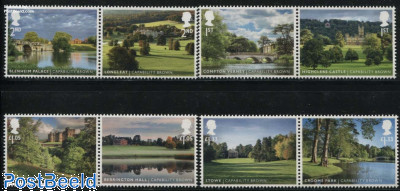
In 2016 Great Britain’s Royal mail produced a set of eight special stamps to mark the 300th anniversary of the birth of Lancelot ‘Capability’ Brown. Capability Brown is remembered as ‘the last of the great eighteenth century artists’ and as ‘England’s greatest gardener’. Nicknamed ‘Capability’ from his habit of describing locations as having ‘great capabilities’, he changed the face of eighteenth century England through his innovative approach to landscape gardening.

He designed the landscapes of country estates, by moving hills and creating flowing lakes and serpentine rivers. He also excavated valleys, planted expanses of turf, clumps of trees and bands of forest. The stamps showcase eight of the best loved examples of Capability Brown’s work and a celebration of his contribution to the English landscape. Locations featured on the stamps are:
Blenheim Palace, Oxfordshire – Often viewed as an example of one of Brown’s finest projects, The Duke of Marlborough enticed Brown to Oxfordshire in 1763, with the promise that he should begin work at Blenheim Palace immediately.
Longleat, Wiltshire – Set in 900 acres of parkland modelled by Brown. For his efforts at Longleat in Wiltshire, Brown was paid over £6,100 between 1757 and 1762 by Lord Weymouth.
Compton Verney, Warwickshire – Brown’s 1768 arrival at Compton Verney, Warwickshire, sparked Lord Willoughby de Broke to undertake ambitious changes to the family seat – including both the house and landscape.
Highclere Castle, Hampshire – Henry Herbert, later 1st Earl of Carnarvon, summoned Brown to Highclere Castle shortly after he inherited the Berkshire estate in 1769. The castle was used as the location for the TV series, Downton Abbey.
Alnwick Castle, Northumberland – Shortly before 1770, Brown began work at the Duke and Duchess of Northumberland’s northern estate, Alnwick Castle, after having previously worked for them at Syon. Northumberland was the county of Brown’s birth.
Berrington Hall, Herefordshire – In 1778, Brown supplied a landscape plan for Thomas Harley at Berrington Hall, Herefordshire, working there in perfect partnership with his son-in-law, the architect, Henry Holland Jnr.
Stowe, Buckinghamshire – The vast Buckinghamshire estate belonging to the formidable Viscount Cobham, was where Brown cut his horticultural teeth. He modelled the Grecian Valley with the Temple of Concord and Victory.
Croome Park, Worcestershire – Brown was first consulted regarding Croome Park in Worcestershire in 1751, when George William Coventry inherited the earldom. This was his first independent commission.
Celebrated for creating landscapes on an immense scale, with a focus on vistas rather than gardens and parkland – it is often said that the images Brown created are as deeply embedded in the English character as the paintings of Turner and the poetry of Wordsworth.


